
Residents Oppose Draft Air Permit for Fairfield Energy Center at Ohio EPA Hearing
Millersport and Buckeye Lake residents raised health concerns over technology exemptions for a 1,350-megawatt plant powering a data center campus.
About 50 people attended an Ohio Environmental Protection Agency hearing in Millersport on Nov. 10, where speakers expressed concerns about a proposed data-center power plant. The public hearing took place at Millersport Elementary School, where speakers raised concerns about health and air pollution from the proposed facility.
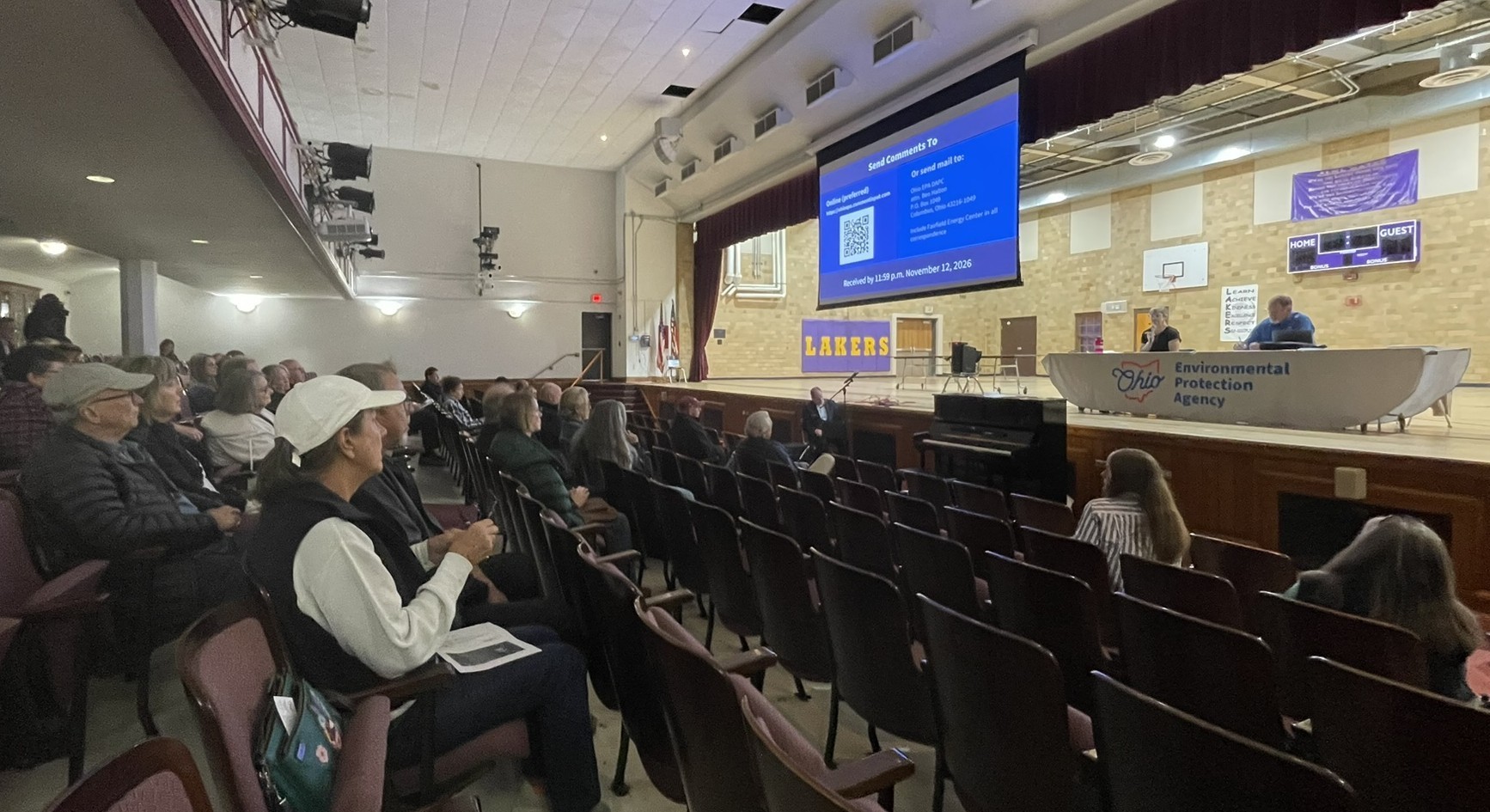
Attendees gather at the Ohio EPA public hearing on the Fairfield Energy Center draft air permit at Millersport Elementary School on Nov. 10, 2026.
Credit: Alan Miller / The Reporting Project Image source
The planned Fairfield Energy Center would supply dedicated power to a neighboring $2.1 billion data center proposed by Vantage Data Centers. According to permit filings, the 1,350-megawatt facility would release an estimated 2,164 tons of air pollutants annually. The plant would also generate more than 7.2 million tons of greenhouse gases each year, an amount state regulators classify as not applicable under Ohio EPA air permit reviews.
Dispute over technology exemptions
State regulations require facilities to install the best available technology when emissions of specific pollutants exceed 10 tons per year. The draft permit to install equipment, which Ohio EPA staff recommends approving, repeatedly exempts emissions from each of the 40 individual turbines and diesel engines from the best available technology requirement.
In its application to the Ohio EPA for the Fairfield Energy Center, the company stated that the facility is expected to produce pollutants well above 10 tons annually, including 333 tons of fine particulate matter and 486 tons of nitrogen oxides. Ohio EPA Press Secretary Bryant Somerville stated that units emitting below 10 tons annually may be exempted under state law. Somerville wrote that the Ohio EPA applies this approach for all air permitting actions statewide.
Cathy Cowan Becker, president of Save Ohio Parks, said regulators issue the permit because each engine emits under 10 tons per year, but argued officials are permitting the entire facility rather than a single engine. At the hearing, Robert Slater II repeated permit application details stating that the planned turbines and backup diesel generators are not the best available technology required by law.
Concerns around Buckeye Lake
Resident Bill Wershing cautioned that the lake basin experiences fog and air inversions that hold pollutants close to the ground. Wershing also voiced outright opposition to the proposal, calling the project a monstrosity of a power plant.
Buckeye Lake Village Council member Kellie Green voiced alarm about potential fallout on the area, warning that air pollution would harm the environment and our communities. Nearby resident Thane Evans used his public comment period to perform an original piano composition titled "The Compromise", stating afterward that the land, health and community are being compromised. Noah Malik of New Albany said he came to the hearing because he wants the EPA to consider the environmental and health effects of multiple behind-the-meter power plants on central Ohio.
Economic claims and comment deadline
Developers project the Fairfield Energy Center would support 2,900 construction jobs and 20 full-time jobs while generating $157 million in property taxes.
Ohio EPA Director John Logue will decide whether to grant the final permit, which agency staff has recommended approving. Public comments on the draft permit may be submitted online through 11:59 p.m. on Thursday, Nov. 12.
How we know this
The sources and records behind this story, with the facts they support.
Supporting evidence (9)
About 50 people attended an Ohio Environmental Protection Agency hearing in Millersport on Nov. 10, where speakers expressed concerns about a proposed data-center power plant.
Read supporting passage
About 50 people attended an Ohio Environmental Protection Agency hearing in Millersport on Nov. 10, some of whom expressed a host of concerns about a proposed data-center power plant.
The public hearing took place at Millersport Elementary School, where speakers raised concerns about health and air pollution from the proposed facility.
Read supporting passage
Many of those who spoke during the Ohio EPA hearing on the merits of an air-pollution permit for the facility raised concerns about health – and about the equipment that would produce 2,164 tons of air pollutants annually, according to the company’s applications to the Ohio Power Siting Board and the Ohio Environmental Protection Agency.
At the hearing, Robert Slater II repeated permit application details stating that the planned turbines and backup diesel generators are not the best available technology required by law.
Read supporting passage
One after another, such as Robert Slater II, repeated details in the OEPA and OPSB applications for permits that say the company plans to use 40 electricity generating turbines, three diesel-powered back-up generators and a diesel-powered pump for emergency fire suppression that are not the “best available technology” as required by law.
Resident Bill Wershing cautioned that the lake basin experiences fog and air inversions that hold pollutants close to the ground.
Read supporting passage
And Bill Wershing was among several who said the EPA should consider that the micro-climate in the Buckeye Lake region is unique in central Ohio because it is prone to fog and air inversions that can hold whatever is in the air – such as all of those pollutants – close to the ground for long periods of time.
Buckeye Lake Village Council member Kellie Green voiced alarm about potential fallout on the area, warning that air pollution would harm the environment and our communities.
Read supporting passage
And several speakers, such as Buckeye Lake Village Council member Kellie Green, expressed their concern for the environmental – and economic – impact on the Buckeye Lake region because pollution from the power plant would fall on that area and affect “the environment and our communities.”
Nearby resident Thane Evans used his public comment period to perform an original piano composition titled "The Compromise", stating afterward that the land, health and community are being compromised.
Read supporting passage
Evans lives in a Victorian farmstead on Rt. 37 just east of where the hyper-scale data center and power plant site is being stripped of topsoil in preparation for construction. He said after the hearing that he used his five minutes allotted to each speaker to play the piece “because the piano was there and everything is being compromised – the land, our health, the community.”
Noah Malik of New Albany said he came to the hearing because he wants the EPA to consider the environmental and health effects of multiple behind-the-meter power plants on central Ohio.
Read supporting passage
Noah Malik, of New Albany, said he came to the hearing in Millersport because he wants the EPA to consider the big picture – the environmental and health effects of multiple “behind-the-meter” power plants on central Ohio.
Ohio EPA Director John Logue will decide whether to grant the final permit, which agency staff has recommended approving.
Read supporting passage
Ohio EPA Director John Logue will decide whether to approve the air-pollution permit, which the EPA staff has recommended that he approve.
Public comments on the draft permit may be submitted online through 11:59 p.m. on Thursday, Nov. 12.
Read supporting passage
Anyone who wants to comment on the permit request can do so online through 11:59 p.m. on Thursday, Nov. 12.
Supporting evidence (14)
The public hearing took place at Millersport Elementary School, where speakers raised concerns about health and air pollution from the proposed facility.
Read supporting passage
A public hearing on the permit application will be held at 6 p.m. on Tuesday, Nov. 10, at Millersport Elementary School, 11850 Lancaster St. Public comments can be filed online through Nov. 12.
The planned Fairfield Energy Center would supply dedicated power to a neighboring $2.1 billion data center proposed by Vantage Data Centers.
Read supporting passage
The plant would serve a $2.1 billion, hyper-scale data center proposed by Vantage Data Centers, which also operates a hyperscale data center in New Albany.
According to permit filings, the 1,350-megawatt facility would release an estimated 2,164 tons of air pollutants annually.
Read supporting passage
A draft air-pollution permit being considered by the Ohio EPA says the Ohio Administrative Code requirement to use the “best available technology” in such plants to reduce emission of certain dangerous pollutants doesn’t apply to the individual turbines and engines in the 1,350 megawatt power plant.
According to permit filings, the 1,350-megawatt facility would release an estimated 2,164 tons of air pollutants annually.
Read supporting passage
The “Fairfield Energy Center” proposed for a data-center site on 450 acres upwind from Buckeye Lake would produce an estimated 2,164 tons of air pollutants annually, according to the applications by Advanced Power Services of Boston to the Ohio Power Siting Board and the Ohio Environmental Protection Agency.
The plant would also generate more than 7.2 million tons of greenhouse gases each year, an amount state regulators classify as not applicable under Ohio EPA air permit reviews.
Read supporting passage
The Millersport power plant also would produce an estimated 7,232,826 tons of greenhouse gases a year, which Ohio EPA documents say is “not applicable” in its permitting process.
State regulations require facilities to install the best available technology when emissions of specific pollutants exceed 10 tons per year.
Read supporting passage
The administrative code says the best available technology (BAT) is required when pollutants such as volatile organic compounds, large particulate matter, fine particulate matter and sulfur dioxide are expected to be more than 10 tons per year for each of those pollutants.
The draft permit to install equipment, which Ohio EPA staff recommends approving, repeatedly exempts emissions from each of the 40 individual turbines and diesel engines from the best available technology requirement.
Read supporting passage
But the draft permit to install equipment, which the EPA staff recommends approving, repeatedly includes language that says the emissions from each of the 40 individual turbines and diesel engines are exempted from the BAT requirement.
In its application to the Ohio EPA for the Fairfield Energy Center, the company stated that the facility is expected to produce pollutants well above 10 tons annually, including 333 tons of fine particulate matter and 486 tons of nitrogen oxides.
Read supporting passage
In its application to the Ohio EPA for the Fairfield Energy Center – which would be among the largest data-center power plants in Ohio to date – says the facility is expected to produce quantities of pollutants far above 10 tons per year:
In its application to the Ohio EPA for the Fairfield Energy Center, the company stated that the facility is expected to produce pollutants well above 10 tons annually, including 333 tons of fine particulate matter and 486 tons of nitrogen oxides.
Read supporting passage
333 tons per year of fine particulate matter (PM2.5)
In its application to the Ohio EPA for the Fairfield Energy Center, the company stated that the facility is expected to produce pollutants well above 10 tons annually, including 333 tons of fine particulate matter and 486 tons of nitrogen oxides.
Read supporting passage
486 tons per year of nitrogen oxides (NOX)
Ohio EPA Press Secretary Bryant Somerville stated that units emitting below 10 tons annually may be exempted under state law.
Read supporting passage
“Any smaller units where emissions remain below 10 tons per year are not considered significant and may be exempted from BAT requirements under Ohio Revised Code 3704.03,” EPA Press Secretary Bryant Somerville said in the statement.
Somerville wrote that the Ohio EPA applies this approach for all air permitting actions statewide.
Read supporting passage
And he wrote that “Ohio EPA applies this approach for all air permitting actions statewide.”
Cathy Cowan Becker, president of Save Ohio Parks, said regulators issue the permit because each engine emits under 10 tons per year, but argued officials are permitting the entire facility rather than a single engine.
Read supporting passage
said Cathy Cowan Becker of Hilliard, president of Save Ohio Parks
Cathy Cowan Becker, president of Save Ohio Parks, said regulators issue the permit because each engine emits under 10 tons per year, but argued officials are permitting the entire facility rather than a single engine.
Read supporting passage
“Everyone knows this is not the best available technology,” Becker said. “They issue the permit because each engine and turbine emits less than 10 tons per year per pollutant. But they are permitting the entire facility, not a single engine.”
EPA considers power plant for Fairfield County data centers
Supporting evidence (2)
Wershing also voiced outright opposition to the proposal, calling the project a monstrosity of a power plant.
Read supporting passage
"Make no mistake, I do oppose the data center coming in, and I do oppose this monstrosity of a power plant," resident Bill Wershing said.
Developers project the Fairfield Energy Center would support 2,900 construction jobs and 20 full-time jobs while generating $157 million in property taxes.
Read supporting passage
According to the Fairfield Energy Center, the project would support 2,900 construction jobs and 20 full-time jobs. The center would also pay $157 million in property taxes.