
Proposed Columbus Utility Rate Increases Would Add $10.29 a Month for City Households
Columbus City Council holds a first reading Monday, Nov. 16, on 2027 utility rate increases driven by a delayed fourth water plant and federal lead pipe mandate despite rare advisory board opposition.

Columbus City Council member Christopher Wyche speaks during a council meeting at City Hall on Jan. 27, 2025.
Credit: The Columbus Dispatch Image source
Typical Columbus households would pay $10.29 more a month, or $123.48 a year, in combined water, sewer and stormwater bills under proposed 2027 rate increases, according to city water legislation. Ahead of a planned Nov. 23 City Council vote, two members of the city's seven-member advisory board voted against the 18% water rate increase, The Columbus Dispatch reported.
For residents outside city limits, the combined increase for a typical household using 5,236 gallons a month is estimated at $12.68 a month, or $153.16 a year, while income-qualified discount participants would see combined bills rise $7.67 a month. Residential electric customers would also see bills increase by $7.86 to $11.90 a month under a companion proposal.
Columbus City Council is scheduled to hold a first reading at 5 p.m. on Monday, Nov. 16, on the proposed 2027 water rate legislation. Previously, Pique Media reported on the proposed 2027 utility rate increases on Nov. 13.
Rare split on the advisory board
The city's Utility Advisory Board met on Oct. 21 and recommended raising water rates, though two members of the seven-member board—Katie White, executive director of the Central Ohio Area Agency on Aging, and Jackie Gutter, a staff attorney at Legal Aid of Southeast and Central Ohio—voted against the 18% water increase, according to The Columbus Dispatch. The board unanimously backed the 4% sanitary sewer and 2% stormwater hikes, while White also opposed the residential electric increase, The Dispatch reported.
White told The Dispatch that inflation and federal changes to Medicaid and SNAP are already squeezing residents, and she suggested delaying the 18% water hike by a year. "We absolutely need to make sure our water infrastructure is up to date, it just is coming at the cost of residents," White said.
Councilmember Christopher Wyche, who chairs council's Public Utilities and Sustainability Committee, said he understands residents are struggling and noted increased discount outreach while supporting the rate increases, The Dispatch reported. "We have to make adult choices and smart decisions on where we are going from an infrastructure standpoint," Wyche said.
Plant delay and lead pipe mandate
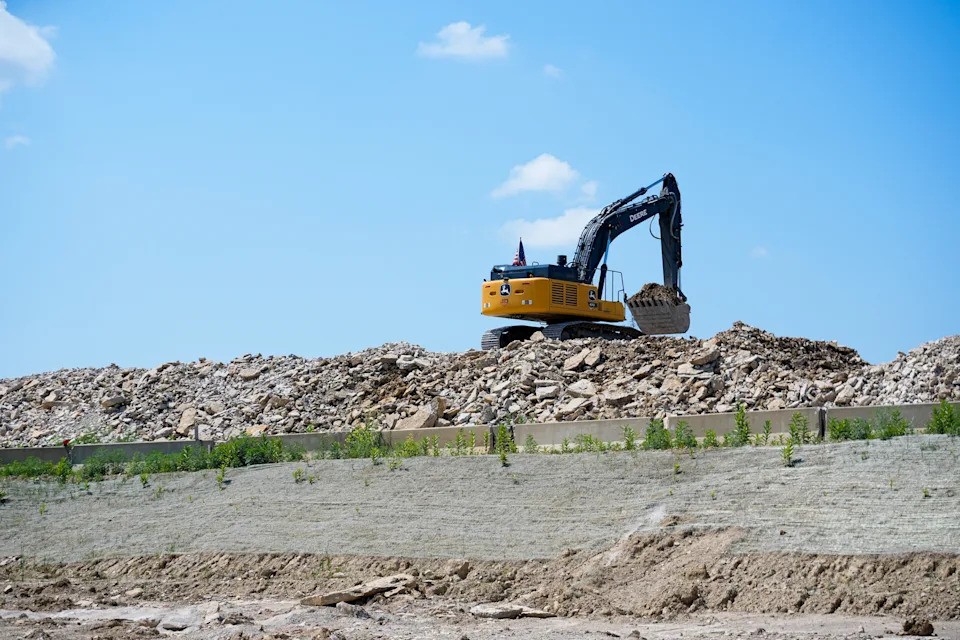
Excavation work at the site of Columbus's planned Home Road fourth water plant in Delaware County, Ohio, on Aug. 6, 2025.
Credit: The Columbus Dispatch Image source
The proposed 18% water rate increase starting Jan. 1, 2027, would generate approximately $46.8 million in additional revenue in fiscal year 2027. For a residential 5/8-inch meter, the monthly service charge would rise from $12.45 to $14.69, while residential usage rates would climb from $4.448 to $5.250 per 100 cubic feet for the first 5 units and from $4.932 to $5.820 above that.
Deputy Water and Power Director Jon Lee warned board members that delaying the water hike could slow the city's planned fourth water plant, The Dispatch reported. After drawing no bids this year at nearly $2 billion, the city is updating plans to re-bid the plant in early 2027 and also faces roughly $1 billion to replace remaining lead service lines under a federal mandate, Lee told The Dispatch. Department filings add that if rates are not increased 18% in 2027, Columbus Water and Power would not meet debt-service coverage ratios needed to sell revenue bonds.
High-demand surcharge and discount gap
The water proposal also creates a $1.62 high-demand surcharge per 100 cubic feet for commercial customers averaging at least 100 units monthly with peak usage at least twice their average. According to WSYX, Lee said about 426 customers would qualify under current modeling, generating an estimated $6 million in revenue. Department filings say the high-demand surcharge is expected to take effect in late 2027 or Jan. 1, 2028.
To cushion household costs, the legislation raises the income-qualified discount from 30% to 35%, allows automatic enrollment, expands eligibility to any household member and continues senior service-charge waivers. Program enrollment has risen 36% in the past year to about 11,800 customers, including about 5,700 seniors, though The Dispatch reported the city still struggles to reach eligible homeowners and renters in apartment complexes with master meters.
How we know this
The sources and records behind this story, with the facts they support.
Supporting evidence (5)
Typical Columbus households would pay $10.29 more a month, or $123.48 a year, in combined water, sewer and stormwater bills under proposed 2027 rate increases, according to city water legislation.
Read supporting passage
With the 2027 rates increases for water, sewer, and storm combined -- based on residential water usage of 5,236 gallons a month, or 175 gallons a day (which is also 7 centum cubic feet (ccf's) per month, or 21 (ccfs) a quarter), City of Columbus residents estimated bill increase is $10.29 per month, or $123.48 per year, or 9.9% above 2026. Income qualified discount participant's estimated monthly bill increase is $7.67 per month, or $92.04 per year, or 9.8% above 2026. Outside city residential customers estimated monthly bill increase is $12.68 a month, or $153.16 a year, or 11.1% above 2026.
For residents outside city limits, the combined increase for a typical household using 5,236 gallons a month is estimated at $12.68 a month, or $153.16 a year, while income-qualified discount participants would see combined bills rise $7.67 a month.
Read supporting passage
With the 2027 rates increases for water, sewer, and storm combined -- based on residential water usage of 5,236 gallons a month, or 175 gallons a day (which is also 7 centum cubic feet (ccf's) per month, or 21 (ccfs) a quarter), City of Columbus residents estimated bill increase is $10.29 per month, or $123.48 per year, or 9.9% above 2026. Income qualified discount participant's estimated monthly bill increase is $7.67 per month, or $92.04 per year, or 9.8% above 2026. Outside city residential customers estimated monthly bill increase is $12.68 a month, or $153.16 a year, or 11.1% above 2026.
The city's Utility Advisory Board met on Oct. 21 and recommended raising water rates, though two members of the seven-member board—Katie White, executive director of the Central Ohio Area Agency on Aging, and Jackie Gutter, a staff attorney at Legal Aid of Southeast and Central Ohio—voted against the 18% water increase, according to The Columbus Dispatch.
Read supporting passage
The Utility Advisory Board (UAB) met on October 21, 2026, and after reviewing Columbus Water and Power's projected expenditures for Fiscal Year 2027, recommends to City Council an increase in such water rates and create a new high demand surcharge for commercial customers.
The proposed 18% water rate increase starting Jan. 1, 2027, would generate approximately $46.8 million in additional revenue in fiscal year 2027.
Read supporting passage
FISCAL IMPACT: These rate increases will generate approximately $46.8 million in additional revenue in Fiscal Year 2027.
To cushion household costs, the legislation raises the income-qualified discount from 30% to 35%, allows automatic enrollment, expands eligibility to any household member and continues senior service-charge waivers.
Read supporting passage
The UAB recommends an increase to the percentage of the discount from 30% to 35%. Columbus Water and Power will also continue the senior income qualified discount that waives the monthly water service charges. The income qualified program is also being amended to allow for automatic enrollment, if applicable, as well as expanded household eligibility to allow any member living in the household to show they meet the program eligibility requirements, not just the individual who the account's name is in.
Supporting evidence (1)
Residential electric customers would also see bills increase by $7.86 to $11.90 a month under a companion proposal.
Read supporting passage
For residential customers, in 2027, depending on rate class, they will see a new monthly bill increase between $7.86 - $11.90 per month, or roughly $94.32 - $142.80 per year.
Supporting evidence (2)
Columbus City Council is scheduled to hold a first reading at 5 p.m. on Monday, Nov. 16, on the proposed 2027 water rate legislation.
Read supporting passage
Header: "Agenda - Tentative," Columbus City Council, Monday, November 16, 2026, 5:00 PM, City Council Chambers, Rm 231. "REGULAR MEETING NO. 51 OF COLUMBUS CITY COUNCIL, NOVEMBER 16, 2026 at 5:00 P.M. IN COUNCIL CHAMBERS." Footer: "Printed on 11/12/2026." Under "FR FIRST READING OF 30-DAY LEGISLATION," RULES & POLICY (HARDIN, CHR. DORANS, VICE CHR.), the agenda lists:
Columbus City Council is scheduled to hold a first reading at 5 p.m. on Monday, Nov. 16, on the proposed 2027 water rate legislation.
Read supporting passage
FR-62 3162-2026 To amend various sections of Chapter 1105 of the Columbus City Codes, to enact new water rates and charges for the year beginning January 1, 2027; to enact a new high demand water surcharge for commercial customers; to expand eligibility for income-qualified and eligible senior customer discount programs; and to repeal the existing sections being amended. Sponsors: Christopher Wyche.
https://www.yahoo.com/news/us/articles/columbus-weighing-18-water-rate-100826436.html
Supporting evidence (14)
Ahead of a planned Nov. 23 City Council vote, two members of the city's seven-member advisory board voted against the 18% water rate increase, The Columbus Dispatch reported.
Read supporting passage
Council intends to vote on the rate increases on Nov. 23.
Ahead of a planned Nov. 23 City Council vote, two members of the city's seven-member advisory board voted against the 18% water rate increase, The Columbus Dispatch reported.
Read supporting passage
At an October meeting of the seven-member Utilities Advisory Board, Katie White, executive director of the Central Ohio Area Agency on Aging, and Jackie Gutter, a staff attorney at Legal Aid of Southeast and Central Ohio, both voted against the 18% increase to water rates. White also voted against a city electric power rate increase.
The city's Utility Advisory Board met on Oct. 21 and recommended raising water rates, though two members of the seven-member board—Katie White, executive director of the Central Ohio Area Agency on Aging, and Jackie Gutter, a staff attorney at Legal Aid of Southeast and Central Ohio—voted against the 18% water increase, according to The Columbus Dispatch.
Read supporting passage
At an October meeting of the seven-member Utilities Advisory Board, Katie White, executive director of the Central Ohio Area Agency on Aging, and Jackie Gutter, a staff attorney at Legal Aid of Southeast and Central Ohio, both voted against the 18% increase to water rates. White also voted against a city electric power rate increase.
The board unanimously backed the 4% sanitary sewer and 2% stormwater hikes, while White also opposed the residential electric increase, The Dispatch reported.
Read supporting passage
The board voted unanimously for a 4% sanitary sewer rate increase and a 2% stormwater rate increases. The votes are only advisory.
The board unanimously backed the 4% sanitary sewer and 2% stormwater hikes, while White also opposed the residential electric increase, The Dispatch reported.
Read supporting passage
At an October meeting of the seven-member Utilities Advisory Board, Katie White, executive director of the Central Ohio Area Agency on Aging, and Jackie Gutter, a staff attorney at Legal Aid of Southeast and Central Ohio, both voted against the 18% increase to water rates. White also voted against a city electric power rate increase.
White told The Dispatch that inflation and federal changes to Medicaid and SNAP are already squeezing residents, and she suggested delaying the 18% water hike by a year.
Read supporting passage
White told The Dispatch that inflation and changes at the federal level to Medicaid and the Supplemental Nutrition Assistance Program (SNAP) are already hitting residents hard right now but she can't control those things.
White told The Dispatch that inflation and federal changes to Medicaid and SNAP are already squeezing residents, and she suggested delaying the 18% water hike by a year.
Read supporting passage
At the utilities advisory board meeting, White suggested delaying the 18% water increase by a year, similar to the city's decision to postpone implementation of a new high-demand water surcharge aimed at data centers.
"We absolutely need to make sure our water infrastructure is up to date, it just is coming at the cost of residents," White said.
Councilmember Christopher Wyche, who chairs council's Public Utilities and Sustainability Committee, said he understands residents are struggling and noted increased discount outreach while supporting the rate increases, The Dispatch reported.
Read supporting passage
Councilmember Christopher Wyche, who chairs council's Public Utilities & Sustainability committee, said he understands people are struggling and that's why the city has increased outreach on its discount programs. Still, he is supporting the rate increases.
"We have to make adult choices and smart decisions on where we are going from an infrastructure standpoint," Wyche said.
Read supporting passage
"We have to make adult choices and smart decisions on where we are going from an infrastructure standpoint," Wyche said. "We cannot wait to build things when we need them because then it will be too late and the cost just continues to go up. I wish we had more road down the line to kick the can, but at this point we're at the wall."
Deputy Water and Power Director Jon Lee warned board members that delaying the water hike could slow the city's planned fourth water plant, The Dispatch reported.
Read supporting passage
However, Deputy Water & Power Director Jon Lee told board members a delay in the 18% water rate increase could further delay the city's planned fourth water plant, which officials say is needed to meet future demand in the growing region.
After drawing no bids this year at nearly $2 billion, the city is updating plans to re-bid the plant in early 2027 and also faces roughly $1 billion to replace remaining lead service lines under a federal mandate, Lee told The Dispatch.
Read supporting passage
After the city received no bids this year to build the plant for nearly $2 billion, the city is updating plans for the project and is targeting putting it back out to bid in early 2027, Lee told The Dispatch. The city also faces about $1 billion in costs to replace its remaining lead service lines under a federal mandate.
Program enrollment has risen 36% in the past year to about 11,800 customers, including about 5,700 seniors, though The Dispatch reported the city still struggles to reach eligible homeowners and renters in apartment complexes with master meters.
Read supporting passage
The number of households signed up for a discount has risen by 36% in the last year to about 11,800 customers, including about 5,700 seniors.
Program enrollment has risen 36% in the past year to about 11,800 customers, including about 5,700 seniors, though The Dispatch reported the city still struggles to reach eligible homeowners and renters in apartment complexes with master meters.
Read supporting passage
The city continues to struggle, however, to get discounts to renters in apartment complexes with master meters. But also many eligible homeowners are not enrolled.
Columbus City Council to Hear First Reading of Proposed 2027 Utility Rate Increases
Supporting evidence (1)
Previously, Pique Media reported on the proposed 2027 utility rate increases on Nov. 13.
Read supporting passage
Columbus City Council to Hear First Reading of Proposed 2027 Utility Rate Increases
Supporting evidence (3)
The proposed 18% water rate increase starting Jan. 1, 2027, would generate approximately $46.8 million in additional revenue in fiscal year 2027.
Read supporting passage
To increase water rates 18% effective January 1, 2027 to cover operating, maintenance, and debt service expenses.
Department filings add that if rates are not increased 18% in 2027, Columbus Water and Power would not meet debt-service coverage ratios needed to sell revenue bonds.
Read supporting passage
Impact of not adopting: "If rates are not increased 18% in 2027 the Water Enterprise may not be able to sufficiently cover its operating expenses or fund its capital improvement program. Also by not adopting the changes the high demand surcharge would not go into effect, nor would the low income qualified discount be increased to help customer affordability. Furthermore, CWP would not meet its debt service coverage ratios to sell revenue bonds."
Department filings say the high-demand surcharge is expected to take effect in late 2027 or Jan. 1, 2028.
Read supporting passage
The high demand surcharge will likely go in effect in late 2027 or January 1, 2028.
Supporting evidence (1)
For a residential 5/8-inch meter, the monthly service charge would rise from $12.45 to $14.69, while residential usage rates would climb from $4.448 to $5.250 per 100 cubic feet for the first 5 units and from $4.932 to $5.820 above that.
Read supporting passage
Rate tables print 2026 and 2027 figures in the same cells. Residential / Commercial-Industrial monthly service charge examples: 5/8 inch meter $12.45 $14.69; 3/4 inch $12.74 $15.03; 1 inch $13.37 $15.78. Residential commodity: First 5 CCF Per Month $4.448 $5.250; All over 5 CCF Per Month $4.932 $5.820; Consecutive Water Systems $4.448 $5.250.
Supporting evidence (3)
The water proposal also creates a $1.62 high-demand surcharge per 100 cubic feet for commercial customers averaging at least 100 units monthly with peak usage at least twice their average.
Read supporting passage
The proposed high-demand surcharge is $1.62 per CCF. According to Lee, about 426 customers would qualify under the current model, generating an estimated $6 million in revenue.
The water proposal also creates a $1.62 high-demand surcharge per 100 cubic feet for commercial customers averaging at least 100 units monthly with peak usage at least twice their average.
Read supporting passage
Under the proposal, commercial customers using at least 100 hundred cubic feet (CCF) of water per month and meeting a peak-demand factor of 2.0 times their typical usage would qualify for the high-demand surcharge.
According to WSYX, Lee said about 426 customers would qualify under current modeling, generating an estimated $6 million in revenue.
Read supporting passage
The proposed high-demand surcharge is $1.62 per CCF. According to Lee, about 426 customers would qualify under the current model, generating an estimated $6 million in revenue.