
Video Watch video 0:38
Mayor Andrew Ginther Proposes $1.3 Billion Columbus Operating Budget Amid Council Feud
The 2027 proposal expands firefighter and police recruitment while cutting funding for health centers serving uninsured residents.
Columbus Mayor Andrew Ginther proposed his 2027 operating budget at the Linden Community Center on Nov. 12, 2026. Ginther's proposed $1.3 billion operating budget would boost firefighter hiring and keep funding stable for homeless shelters. Pitching the budget on Nov. 12 at the Linden Community Center, Ginther cited economic pressures that held him back from funding everything he would like to, such as a third police recruit class.
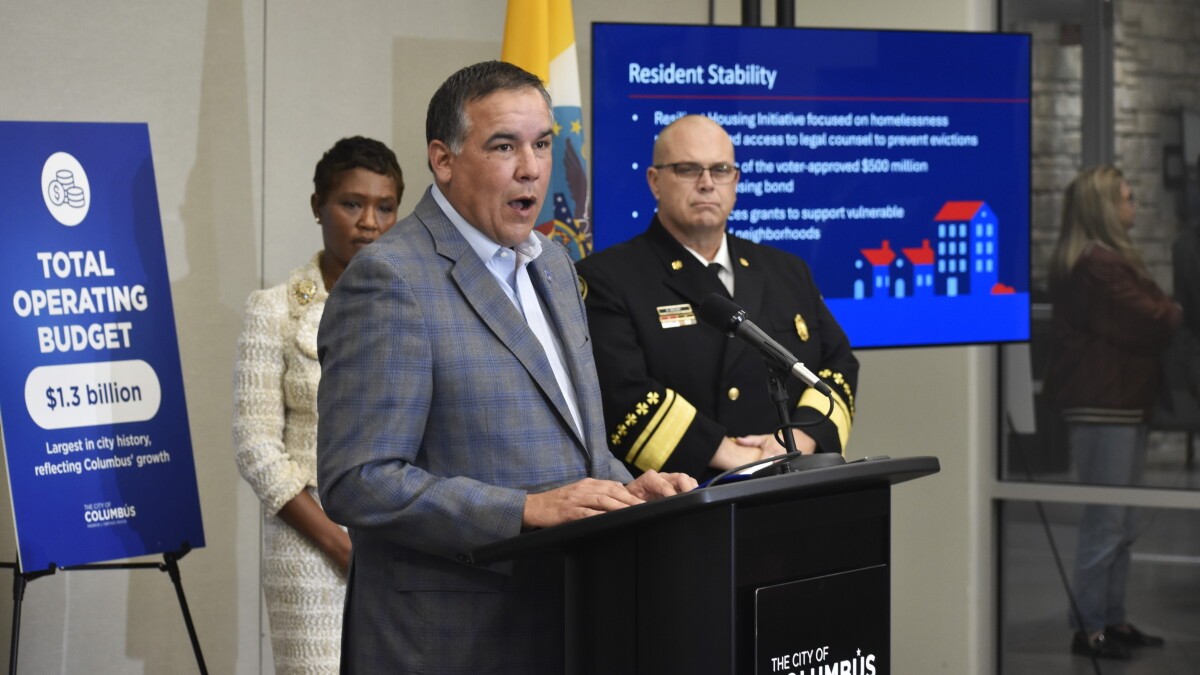
Columbus Mayor Andrew Ginther presents the proposed $1.3 billion 2027 city operating budget during a press conference at the Linden Community Center on Nov. 12, 2026.
Credit: George Shillcock / WOSU Image source
Public safety hiring and overtime adjustments
Ginther is proposing three fire recruit classes in 2027 that could add up to 135 new firefighters and two police recruit classes that could add up to 120 new officers, after the city funded only one fire class over the last two years. The increased investment in Division of Fire recruitment comes amid a staffing shortage that led the division to blow through its overtime budget this year, exacerbated when the city opened another fire station midway through 2026.
Ginther's budget proposal includes more than $44 million for public safety overtime, matching what the city projects will be used in 2026 according to Finance Director Chris Long. Columbus is projected to go over budget on police and fire overtime in 2026 by at least $23 million after Public Safety missed overtime reductions baked into the 2026 budget.
Earlier this year, Columbus voters overwhelmingly supported Issue 5, which sends clinicians rather than police officers to some nonviolent mental health crises. Ginther's budget for 2026 included $8.8 million for alternative crisis response, but his proposal for 2027 reduced that amount to $6.1 million. Long said the budget reflects an efficient allocation of those safety resources, so not scaling back those programs.
Health cuts, homeless shelters and Columbus Promise
Ginther's 2027 budget proposal includes $13 million for homelessness response through the Community Shelter Board, after council amended the budget last year to bring the total to $13 million. At the press conference, Community Shelter Board CEO Shannon Isom thanked the mayor for the 2027 commitment. Isom said the mayor has put in a substantial amount of money that ensures support systems and shelter systems will be maintained while allowing the organization to think creatively for a growing community.
Ginther's proposal has $0 for health centers like PrimaryOne Health, which serve low-income residents without medical insurance. Historically, the city provided about $5 million annually to PrimaryOne Health before cutting funding in recent years. In his 2026 proposal, Ginther cut funding for PrimaryOne Health to less than $1 million before council action added back funding to $1.8 million for the network of health centers.
PrimaryOne Health CEO Fikru Nigusse told The Dispatch that the planned reduction would be tough to absorb, especially considering federal cuts to Medicaid. Nigusse said PrimaryOne Health will again seek budget changes from City Council members to add funding for their centers.
The Columbus Promise, a widely popular program, sends Columbus City Schools graduates to Columbus State Community College tuition-free and helps prepare students for college. In his 2027 budget proposal, Ginther includes $1 million for the program, after including nothing last year before council added back $2 million.
Ginther pledged in 2025 that the city would contribute ten million dollars to the program under a three-year pledge. To meet that commitment, the city would need to allocate six million dollars in 2027, meaning the city will not meet Ginther's commitment as it stands. Asked about not making the city's commitment, Ginther said it was a missed opportunity for Columbus State to not put a levy on the ballot this year.
Reserve fund clash and council review
The mayor's proposal is the first step in a process that will play out against an ongoing political feud between Ginther and City Council President Shannon Hardin, who is challenging the mayor in the 2027 election. The proposed public safety investment also follows an endorsement for Hardin from the firefighters' union in the mayoral contest announced a day before. Hardin said in a statement that residents deserve a budget that plans for a better future without accounting tricks.
Previously, Pique reported on City Council's move to cap operational withdrawals from the income tax reserve on Oct. 29, 2026. Under the council legislation, miscellaneous non-personnel operating expenses from the reserve face spending restrictions capping them at 90 percent of the total spent in that category during the prior fiscal year beginning Jan. 1, 2027.
Council approved the legislation by an 8-0 vote introduced by Hardin and supported by City Auditor Jacquelin Lewis, saying the code change was a fiscally responsible move aimed at protecting the city's credit rating. After City Council voted ten days ago to restrict withdrawals from the debt services fund, Ginther said he will not sign the legislation, a rare symbolic move, though the legislation will still take effect without his signature.
Ginther said the impact of the council restrictions this budget cycle was approximately $5 million that could not be used for operating costs. Council will hold budget hearings in the coming months before a vote in early 2027.
How we know this
The sources and records behind this story, with the facts they support.
https://www.yahoo.com/news/politics/articles/ginther-budget-cuts-health-spending-172558630.html
Supporting evidence (30)
Columbus Mayor Andrew Ginther proposed his 2027 operating budget at the Linden Community Center on Nov. 12, 2026.
Ginther's proposed $1.3 billion operating budget would boost firefighter hiring and keep funding stable for homeless shelters.
Read supporting passage
Ginther's proposed $1.3 billion operating budget would boost firefighter hiring and keep funding stable for the homeless shelters.
Pitching the budget on Nov. 12 at the Linden Community Center, Ginther cited economic pressures that held him back from funding everything he would like to, such as a third police recruit class.
Read supporting passage
Ginther, who is required by city charter to submit an annual operating budget by mid-November, pitched his budget on Nov. 12 at Linden Community Center while saying economic pressures held him back from funding everything he would like to, such as a third police recruit class.
Ginther is proposing three fire recruit classes in 2027 that could add up to 135 new firefighters and two police recruit classes that could add up to 120 new officers, after the city funded only one fire class over the last two years.
Read supporting passage
Ginther is proposing three fire recruit classes in 2027 that could add up to 135 new firefighters and two police recruit classes that could add up to 120 new officers. The last two years, the city has funded only one fire class.
The increased investment in Division of Fire recruitment comes amid a staffing shortage that led the division to blow through its overtime budget this year, exacerbated when the city opened another fire station midway through 2026.
Read supporting passage
The increased investment in Division of Fire recruitment comes amid a staffing shortage that lead the division to blow through its overtime budget this year. The problem was exacerbated mid-way through 2026 when the city opened another fire station.
Ginther's budget proposal includes more than $44 million for public safety overtime, matching what the city projects will be used in 2026 according to Finance Director Chris Long.
Read supporting passage
Ginther's budget proposal includes over $44 million for police and fire overtime, that is about what the city projects will be used in 2026, according to Ginther's finance director, Chris Long.
Columbus is projected to go over budget on police and fire overtime in 2026 by at least $23 million after Public Safety missed overtime reductions baked into the 2026 budget.
Read supporting passage
This year, the 2026 budget baked in ambitious overtime reductions that the Department of Public Safety did not hit. Council criticized the overtime allotment as wishful thinking but did not amend it when passing the 2026 operating budget. Columbus is projected to go over budget on police and fire overtime in 2026 by at least $23 million.
Earlier this year, Columbus voters overwhelmingly supported Issue 5, which sends clinicians rather than police officers to some nonviolent mental health crises.
Read supporting passage
Columbus voters overwhelmingly supported Issue 5 earlier this year, which sends clinicians, rather than police officers, to some nonviolent mental health crises.
Ginther's budget for 2026 included $8.8 million for alternative crisis response, but his proposal for 2027 reduced that amount to $6.1 million.
Read supporting passage
Ginther's budget for 2026 included $8.8 million for alternative crisis response but his proposal for 2027 reduced that amount to $6.1 million.
Long said the budget reflects an efficient allocation of those safety resources, so not scaling back those programs.
Read supporting passage
Long said the budget reflects an "efficient allocation of those safety resources, so not scaling back those programs."
Ginther's 2027 budget proposal includes $13 million for homelessness response through the Community Shelter Board, after council amended the budget last year to bring the total to $13 million.
Read supporting passage
Ginther's 2027 budget proposal includes $13 million for the Community Shelter Board, the nonprofit that manages Franklin County's homelessness response. Last year, Ginther proposed allocating about $6 million to CSB and council amended the budget to bring the total to $13 million.
At the press conference, Community Shelter Board CEO Shannon Isom thanked the mayor for the 2027 commitment.
Read supporting passage
Community Shelter Board CEO Shannon Isom thanked the mayor for the 2027 commitment at the press conference.
Isom said the mayor has put in a substantial amount of money that ensures support systems and shelter systems will be maintained while allowing the organization to think creatively for a growing community.
Read supporting passage
"The mayor has put in a substantial amount of money that ensures not only our support systems, our shelter systems will be maintained, but instead allows us to think creatively, innovatively for a growing community," said Community Shelter Board CEO Shannon Isom.
Ginther's proposal has $0 for health centers like PrimaryOne Health, which serve low-income residents without medical insurance.
Read supporting passage
Ginther's proposal has $0 for Federally Qualified Health Centers like PrimaryOne Health, which serve low-income residents without medical insurance.
Historically, the city provided about $5 million annually to PrimaryOne Health before cutting funding in recent years.
Read supporting passage
Historically, the city provided about $5 million annually to PrimaryOne Health but has cut funding in recent years.
In his 2026 proposal, Ginther cut funding for PrimaryOne Health to less than $1 million before council action added back funding to $1.8 million for the network of health centers.
Read supporting passage
In his 2026 proposal, Ginther cut funding for PrimaryOne Health to less than $1 million but City Council added back funding to $1.8 million for the network of health centers.
PrimaryOne Health CEO Fikru Nigusse told The Dispatch that the planned reduction would be tough to absorb, especially considering federal cuts to Medicaid.
Read supporting passage
PrimaryOne Health CEO Fikru Nigusse told The Dispatch after the mayor's announcement that a cut of this magnitude would be a tough one to swallow, especially considering all the cuts at the federal level to Medicaid.
Nigusse said PrimaryOne Health will again seek budget changes from City Council members to add funding for their centers.
Read supporting passage
Nigusse said PrimaryOne Health will again lobby City Council members to amend the budget and add funding for their centers.
The Columbus Promise, a widely popular program, sends Columbus City Schools graduates to Columbus State Community College tuition-free and helps prepare students for college.
Read supporting passage
Last budget cycle, funding the city's commitment to the Columbus Promise was a hot-button topic. The widely popular program, Hardin's brain-child, sends Columbus City Schools graduates to Columbus State Community College tuition-free and helps prepare students for college.
In his 2027 budget proposal, Ginther includes $1 million for the program, after including nothing last year before council added back $2 million.
Read supporting passage
In his 2027 budget proposal, Ginther includes $1 million for the Columbus Promise. Last year, Ginther included nothing for the program and Hardin slammed Ginther for it as council added back $2 million.
Ginther pledged in 2025 that the city would contribute ten million dollars to the program under a three-year pledge.
Read supporting passage
Still, Ginther pledged in 2025 that the city would contribute $10 million to the program over three years.
To meet that commitment, the city would need to allocate six million dollars in 2027, meaning the city will not meet Ginther's commitment as it stands.
Read supporting passage
To meet that commitment, the city would need to allocate $6 million in 2027. As it stands, the city won't meet Ginther's commitment.
Asked about not making the city's commitment, Ginther said it was a missed opportunity for Columbus State to not put a levy on the ballot this year.
Read supporting passage
Asked about not making the city's commitment, Ginther said it was a missed opportunity for Columbus State to not put a levy on the ballot this year and encouraged them to do so in the future so CCS and graduates from all Franklin County high schools could benefit.
The mayor's proposal is the first step in a process that will play out against an ongoing political feud between Ginther and City Council President Shannon Hardin, who is challenging the mayor in the 2027 election.
Read supporting passage
The mayor's proposal is the first step in a process that will play out against a feud between Ginther and City Council President Shannon Hardin, who is challenging the mayor in the 2027 election.
The proposed public safety investment also follows an endorsement for Hardin from the firefighters' union in the mayoral contest announced a day before.
Read supporting passage
The proposed investment comes too late to sway the firefighters' union, which endorsed Hardin in the mayoral contest a day before.
Hardin said in a statement that residents deserve a budget that plans for a better future without accounting tricks.
Read supporting passage
Hardin said in a statement that residents deserve a budget that not only ensures everyday services continue, but also plans for a better future for all. He said this has to be done without accounting tricks.
Council approved the legislation by an 8-0 vote introduced by Hardin and supported by City Auditor Jacquelin Lewis, saying the code change was a fiscally responsible move aimed at protecting the city's credit rating.
Read supporting passage
Council voted 8-0 originally for the legislation introduced by Hardin and supported by City Auditor Jacquelin Lewis. Council and Lewis said the code change was a fiscally responsible move aimed at protective the city's perfect credit rating.
After City Council voted ten days ago to restrict withdrawals from the debt services fund, Ginther said he will not sign the legislation, a rare symbolic move, though the legislation will still take effect without his signature.
Read supporting passage
After City Council voted ten days ago to restrict how much the operating budget can pull from the city's debt services fund, Ginther said he will not sign the legislation. It's a rare, symbolic move for Ginther but the legislation will still take effect without his signature.
Ginther said the impact of the council restrictions this budget cycle was approximately $5 million that could not be used for operating costs.
Read supporting passage
The impact this budget cycle was about $5 million that could not be used for operating costs, Ginther said.
Council will hold budget hearings in the coming months before a vote in early 2027.
Read supporting passage
Council will hold hearings on the operating budget in the coming months before a vote in early 2027.
Columbus City Council Moves to Cap Operational Spending From Income Tax Reserve
Supporting evidence (2)
Previously, Pique reported on City Council's move to cap operational withdrawals from the income tax reserve on Oct. 29, 2026.
Read supporting passage
Columbus City Council Moves to Cap Operational Spending From Income Tax Reserve
Under the council legislation, miscellaneous non-personnel operating expenses from the reserve face spending restrictions capping them at 90 percent of the total spent in that category during the prior fiscal year beginning Jan. 1, 2027.
Read supporting passage
Beginning Jan. 1, 2027, miscellaneous non-personnel operating expenses cannot exceed 90 percent of the total spent in that category during the prior fiscal year.