
Ohio Voters Decide Whether to Enshrine Voter Photo ID in State Constitution
Issue 3 would enact Section 5 of Article V of the Ohio Constitution, adding a voter photo ID requirement currently required under state law.
Voting is underway across Ohio on Tuesday as voters cast ballots on Issue 3, deciding whether to place voter photo identification requirements into the state constitution. On Election Day, polling locations are open from 6:30 a.m. to 7:30 p.m. Official totals will be reported by the Ohio Secretary of State after polling places close at 7:30 p.m.
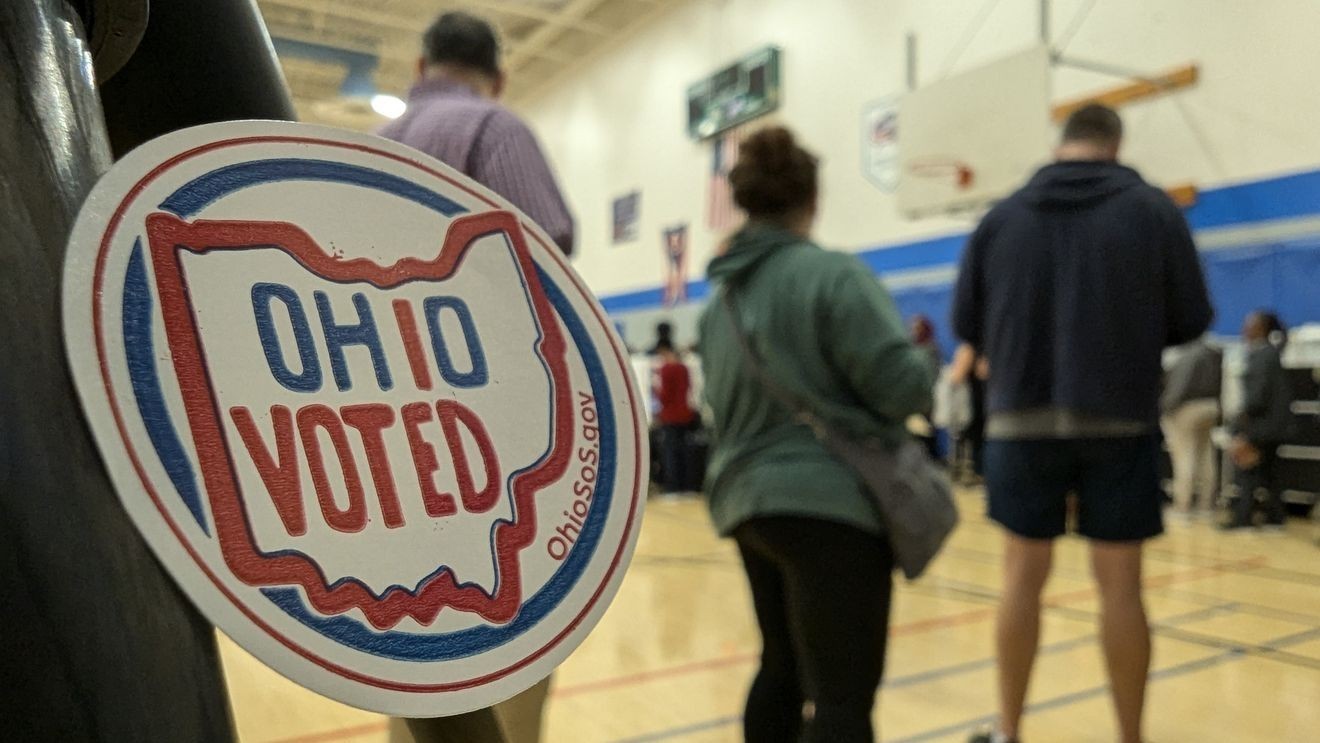
An 'Ohio Voted' sticker is displayed at a polling station as voters cast ballots in the general election.
Credit: WSYX / ABC 6 Image source
The ballot measure represents a legislative proposal from Republican lawmakers to amend the Ohio Constitution to include a voter photo ID requirement currently required under state law. A majority yes vote is required for adoption of Section 5, which will take effect immediately if approved.
Proposed Constitutional Language
The proposed amendment seeks to enact Section 5 of Article V of the Ohio Constitution.
Under Section 5, electors must provide photo identification in order to vote in person at a polling place or other voting location designated by law, except that laws may provide an alternative method of verifying the identity of an elector who has a sincere religious objection to being photographed.
For ballots cast outside of in-person polling places, electors would be required at a minimum to provide identification or unique identifiers as authorized by law. The proposal specifies that an other unique identifier means a unique numeric or alphanumeric descriptor assigned to the elector by an agency of Ohio or the United States, or a truncated version authorized by law for voting purposes.
The amendment defines approved photo identification as unexpired government-issued identification that includes the elector's name and photograph. The official ballot explanation specifies that qualifying forms of identification include an unexpired Ohio driver's license or state identification card, a United States passport or passport card, a United States military identification card, an Ohio National Guard identification card, or a United States Department of Veterans Affairs identification card.
Current Statute Versus Constitutional Amendment
Ohio law already requires citizens to provide photo identification before voting thanks to legislation lawmakers passed in 2022 that took effect in 2023. That statutory standard established that voters must present unexpired government-issued photo identification to vote in person.
Because those rules exist only in state statute, lawmakers could modify them through ordinary legislation. The Ohio House passed Senate Joint Resolution 10 61-27, meeting the 60% House approval threshold after the Ohio Senate passed the resolution.
If voters approve the amendment, further constitutional revision would be required to alter the rules, a process requiring approval from more than 50% of Ohio voters once reaching the ballot.
Jen Miller, executive director of the Ohio League of Women voters, explained that "Some think that having it in the Constitution protects this from getting removed by the Ohio General Assembly," while others say that is problematic if voter ID laws need to be updated. Regardless of whether Issue 3 passes or fails, Ohio's voter ID requirements will remain unchanged.
Official Ballot Arguments
On July 24, 2026, legislative leaders designated bipartisan drafting teams to write arguments for and against the ballot measure.
The legislative leaders appointed four Republican lawmakers — Rep. Adam Bird, Rep. Heidi Workman, Sen. Jane Timken, and Sen. Theresa Gavarone — to draft the official argument in support of Issue 3.
To prepare the opposing argument, legislative leaders tapped three Democratic lawmakers — Rep. Desiree Tims, Rep. Terrence Upchurch, and Sen. Bill DeMora.
Advocates wrote in the official Vote YES filing that "This commonsense requirement will protect Ohio’s elections and is the standard to obtain a job, rent an apartment, board a plane, or drive a car."
Opponents wrote in the official Vote No filing that "Issue 3 is nothing more than a partisan power grab by out-of-state elites who want to rig Ohio’s elections."
Cross-Party Debates and Sourced Views
State Rep. Adam Bird, R-New Richmond, called it "a simple proposal that will give (voters) the opportunity to protect the foundations of our constitutional republic, that means free and fair elections."
Vivek Ramaswamy, the Republican candidate for governor, called the measure common sense, arguing, "Number one is it actually says you need a photo ID to vote, but number two is it also builds up our public trust in the democratic process."
“We should be protecting elections here in the state of Ohio,” Robert Sprague, the Republican nominee for secretary of state, said.
Proponents also note that voting yes on Issue 3 means making current voter ID requirements more difficult to change by enshrining them in the Ohio Constitution.
Democratic candidate for Ohio governor Amy Acton broke with her party to support Issue 3, an amendment proposed by Republican lawmakers to enshrine the voter photo ID requirement in the state constitution.
“This amendment has overwhelming support from Ohioans across the state,” Acton said, adding, “As this doesn’t change what is already law, as governor, I will support it.”
State Rep. Allison Russo, D-Upper Arlington, said Ohio's "current form of photo identification and the laws that govern it are working as they were intended."
"We are spending all of our energy and time on putting something that is already the law as it relates to voter ID into the Constitution," Isaacsohn said.
Libertarian gubernatorial candidate Don Kissick stated, "My concern with taking what is already law in Ohio and forcing it into our constitution is the potential for unintended consequences, by giving the state a green light to pass ill-advised, restrictive laws we don’t really need."
Tom Pruss, the Libertarian candidate for secretary of state, opposed the amendment as political theatre.
Pruss warned that the proposal gives lawmakers "significant power to restrict mail voting later, potentially affecting seniors, military personnel, voters with disabilities, rural residents, shift workers, and others who cannot easily vote in person."
With voting underway Tuesday, Ohio voters will determine whether to embed voter photo identification into the state's governing document.
How we know this
The sources and records behind this story, with the facts they support.
Supporting evidence (10)
On Election Day, polling locations are open from 6:30 a.m. to 7:30 p.m.
Read supporting passage
Election Day: Polls are open from 6:30 a.m. to 7:30 p.m.
The ballot measure represents a legislative proposal from Republican lawmakers to amend the Ohio Constitution to include a voter photo ID requirement currently required under state law.
Read supporting passage
Ohio Issue 3 is a proposal to voters from Ohio Republican lawmakers to amend the Ohio Constitution to include a voter photo ID requirement, which is currently required under state law.
A majority yes vote is required for adoption of Section 5, which will take effect immediately if approved.
Read supporting passage
A majority yes vote is required for the adoption of Section 5.
A majority yes vote is required for adoption of Section 5, which will take effect immediately if approved.
Read supporting passage
If approved, the amendment shall take effect immediately.
The proposed amendment seeks to enact Section 5 of Article V of the Ohio Constitution.
Read supporting passage
To enact Section 5 of Article V of the Constitution of the State of Ohio
Under Section 5, electors must provide photo identification in order to vote in person at a polling place or other voting location designated by law, except that laws may provide an alternative method of verifying the identity of an elector who has a sincere religious objection to being photographed.
Read supporting passage
Section 5. (A) Electors shall provide photo identification in order to vote in person at a polling place or other voting location designated by law, in accordance with laws passed by the general assembly, except that the laws may provide an alternative method of verifying the identity of an elector who does not have photo identification because the elector has a sincere religious objection to being photographed.
For ballots cast outside of in-person polling places, electors would be required at a minimum to provide identification or unique identifiers as authorized by law.
Read supporting passage
(B) At a minimum, and in accordance with laws passed by the general assembly, electors shall provide photo identification or, if authorized by law, a signature and at least one other unique identifier in order to vote by any other method authorized by law.
The proposal specifies that an other unique identifier means a unique numeric or alphanumeric descriptor assigned to the elector by an agency of Ohio or the United States, or a truncated version authorized by law for voting purposes.
Read supporting passage
(2) “Other unique identifier” means one of the following that is authorized by the general assembly by law for voting purposes: (a) A unique numeric or alphanumeric descriptor assigned to the elector by an agency of this state or the United States; (b) A truncated version of a descriptor described in division (C)(2)(a) of this section.
The amendment defines approved photo identification as unexpired government-issued identification that includes the elector's name and photograph.
Read supporting passage
(1) “Photo identification” means one of the following documents that is issued by an agency of this state or the United States, includes the elector’s name and photograph, and is not expired:
The official ballot explanation specifies that qualifying forms of identification include an unexpired Ohio driver's license or state identification card, a United States passport or passport card, a United States military identification card, an Ohio National Guard identification card, or a United States Department of Veterans Affairs identification card.
Read supporting passage
Define approved forms of government-issued photo identification as an unexpired Ohio driver license or state identification card; a United States passport or passport card; or a United States military identification card, Ohio National Guard identification card, or United States Department of Veterans Affairs identification card.
Supporting evidence (5)
Ohio law already requires citizens to provide photo identification before voting thanks to legislation lawmakers passed in 2022 that took effect in 2023.
Read supporting passage
Ohio law already requires citizens to provide photo identification before voting thanks to a bill the lawmakers passed in 2022 and took effect in 2023.
The Ohio House passed Senate Joint Resolution 10 61-27, meeting the 60% House approval threshold after the Ohio Senate passed the resolution.
Read supporting passage
The Ohio House passed Senate Joint Resolution 10 61-27 during Wednesday’s marathon session. The resolution needed 60% of Ohio House members to approve the resolution, which the Ohio Senate easily passed last week.
State Rep. Adam Bird, R-New Richmond, called it "a simple proposal that will give (voters) the opportunity to protect the foundations of our constitutional republic, that means free and fair elections."
Read supporting passage
“It’s a simple proposal that will give (voters) the opportunity to protect the foundations of our constitutional republic, that means free and fair elections,” said state Rep. Adam Bird, R-New Richmond.
State Rep. Allison Russo, D-Upper Arlington, said Ohio's "current form of photo identification and the laws that govern it are working as they were intended."
Read supporting passage
“Our current form of photo identification and the laws that govern it are working as they were intended, yet many of my colleagues across the aisle have decided today that the urgent issue of the moment …. is to turn this existing law that is already working into a change in our constitution,” said state Rep. Allison Russo, D-Upper Arlington.
"We are spending all of our energy and time on putting something that is already the law as it relates to voter ID into the Constitution," Isaacsohn said.
Read supporting passage
“We are spending all of our energy and time on putting something that is already the law as it relates to voter ID into the Constitution,” he said. “It’s not going to change a single person’s life. … We already have safe and secure and stable elections.”
https://www.wlwt.com/article/ohio-2026-midterm-elections-what-is-issue-3-explainer/74308373
Supporting evidence (5)
If voters approve the amendment, further constitutional revision would be required to alter the rules, a process requiring approval from more than 50% of Ohio voters once reaching the ballot.
Read supporting passage
If the amendment is approved, any changes to the rules would require an amendment to Ohio's constitution, a lengthy process that requires approval from more than 50 percent of Ohio voters once reaching the ballot.
Jen Miller, executive director of the Ohio League of Women voters, explained that "Some think that having it in the Constitution protects this from getting removed by the Ohio General Assembly," while others say that is problematic if voter ID laws need to be updated.
Read supporting passage
Jen Miller is the executive director of the Ohio League of Women voters, which did not take a stance on the proposed amendment. Miller explains the key arguments from those for and against the changes to Ohio’s constitution. "Some think that having it in the Constitution protects this from getting removed by the Ohio General Assembly,” Miller said. “While others would say it's not necessary to put it in the Ohio Constitution, and fact, that's problematic, because if we need to update our voter ID laws, we would have to go through another constitutional amendment process.”
Regardless of whether Issue 3 passes or fails, Ohio's voter ID requirements will remain unchanged.
Advocates wrote in the official Vote YES filing that "This commonsense requirement will protect Ohio’s elections and is the standard to obtain a job, rent an apartment, board a plane, or drive a car."
Read supporting passage
“This commonsense requirement will protect Ohio’s elections and is the standard to obtain a job, rent an apartment, board a plane, or drive a car,” advocates wrote in the official Vote YES on Issue 3 filing.
Opponents wrote in the official Vote No filing that "Issue 3 is nothing more than a partisan power grab by out-of-state elites who want to rig Ohio’s elections."
Read supporting passage
“Issue 3 is nothing more than a partisan power grab by out-of-state elites who want to rig Ohio’s elections,” opponents wrote in the official Vote No on Issue 3 filing.
Supporting evidence (3)
On July 24, 2026, legislative leaders designated bipartisan drafting teams to write arguments for and against the ballot measure.
Read supporting passage
Four Republicans were appointed to write arguments in favor of Issue 3, the constitutional amendment that will appear on the November 2026 ballot requiring photo identification to vote, while three Democrats were chosen to write the arguments against the issue.
The legislative leaders appointed four Republican lawmakers — Rep. Adam Bird, Rep. Heidi Workman, Sen. Jane Timken, and Sen. Theresa Gavarone — to draft the official argument in support of Issue 3.
Read supporting passage
This week, the leaders tapped Reps. Adam Bird (R-Cincinnati) and Heidi Workman (R-Rootstown) and Sens. Jane Timken (R-Canton) and Theresa Gavarone (R-Bowling Green) to write the arguments for the issue
To prepare the opposing argument, legislative leaders tapped three Democratic lawmakers — Rep. Desiree Tims, Rep. Terrence Upchurch, and Sen. Bill DeMora.
Read supporting passage
Reps. Desiree Tims (D-Dayton) and Terrence Upchurch (D-Cleveland) and Sen. Bill DeMora (D-Columbus) were designated to write the arguments against Issue 3.
Supporting evidence (4)
Vivek Ramaswamy, the Republican candidate for governor, called the measure common sense, arguing, "Number one is it actually says you need a photo ID to vote, but number two is it also builds up our public trust in the democratic process."
Read supporting passage
“That’s common sense,” Vivek Ramaswamy, the Republican candidate for governor, said Friday. A future General Assembly could reverse the law, unless it’s in the Constitution. “Number one is it actually says you need a photo ID to vote, but number two is it also builds up our public trust in the democratic process,” Ramaswamy continued.
Democratic candidate for Ohio governor Amy Acton broke with her party to support Issue 3, an amendment proposed by Republican lawmakers to enshrine the voter photo ID requirement in the state constitution.
Read supporting passage
Democratic candidate for Ohio governor Amy Acton is breaking with her party to support Issue 3, an amendment proposed by Republican lawmakers to enshrine the state’s voter photo ID requirement in the state constitution.
“This amendment has overwhelming support from Ohioans across the state,” Acton said, adding, “As this doesn’t change what is already law, as governor, I will support it.”
Read supporting passage
“This amendment has overwhelming support from Ohioans across the state,” Acton said. “As this doesn’t change what is already law, as governor, I will support it.”
Libertarian gubernatorial candidate Don Kissick stated, "My concern with taking what is already law in Ohio and forcing it into our constitution is the potential for unintended consequences, by giving the state a green light to pass ill-advised, restrictive laws we don’t really need."
Read supporting passage
“My concern with taking what is already law in Ohio and forcing it into our constitution is the potential for unintended consequences, by giving the state a green light to pass ill-advised, restrictive laws we don’t really need,” Kissick said.
https://ohiocapitaljournal.com/2026/07/29/what-is-issue-3-on-the-ohio-ballot/
Supporting evidence (4)
“We should be protecting elections here in the state of Ohio,” Robert Sprague, the Republican nominee for secretary of state, said.
Proponents also note that voting yes on Issue 3 means making current voter ID requirements more difficult to change by enshrining them in the Ohio Constitution.
Read supporting passage
Voting yes on Issue 3 means you want to make the current voter ID requirements more difficult to change by enshrining them in the Ohio Constitution.
Tom Pruss, the Libertarian candidate for secretary of state, opposed the amendment as political theatre.
Read supporting passage
Tom Pruss, the Libertarian secretary of state candidate, is opposed to the amendment, calling it “political theatre.”
Pruss warned that the proposal gives lawmakers "significant power to restrict mail voting later, potentially affecting seniors, military personnel, voters with disabilities, rural residents, shift workers, and others who cannot easily vote in person."
Read supporting passage
“That gives partisan lawmakers significant power to restrict mail voting later, potentially affecting seniors, military personnel, voters with disabilities, rural residents, shift workers, and others who cannot easily vote in person,” Pruss said.