
Ohio State's Chase Center Partners With Reagan Institute on Early Career Fellowship
The multiyear program offers research salaries, university appointments and faculty development grants.
The Ohio State University has joined the Ronald Reagan Presidential Foundation and Institute to launch a multiyear early career fellowship program intended to establish a direct pathway toward tenure-track positions. Ohio State, through the Salmon P. Chase Center for Civics, Culture, and Society, is a founding partner with four other institutions, including Dartmouth College, George Washington University, the University of Wisconsin–Madison, and Vanderbilt University.
The society is accepting applications for its inaugural cohort of fellows, with appointments scheduled to begin Sept. 1, 2027. The society supports eligible scholars focused on five core fields: U.S. political history, America in the world, civic thought, science and technology studies, and law and economics.
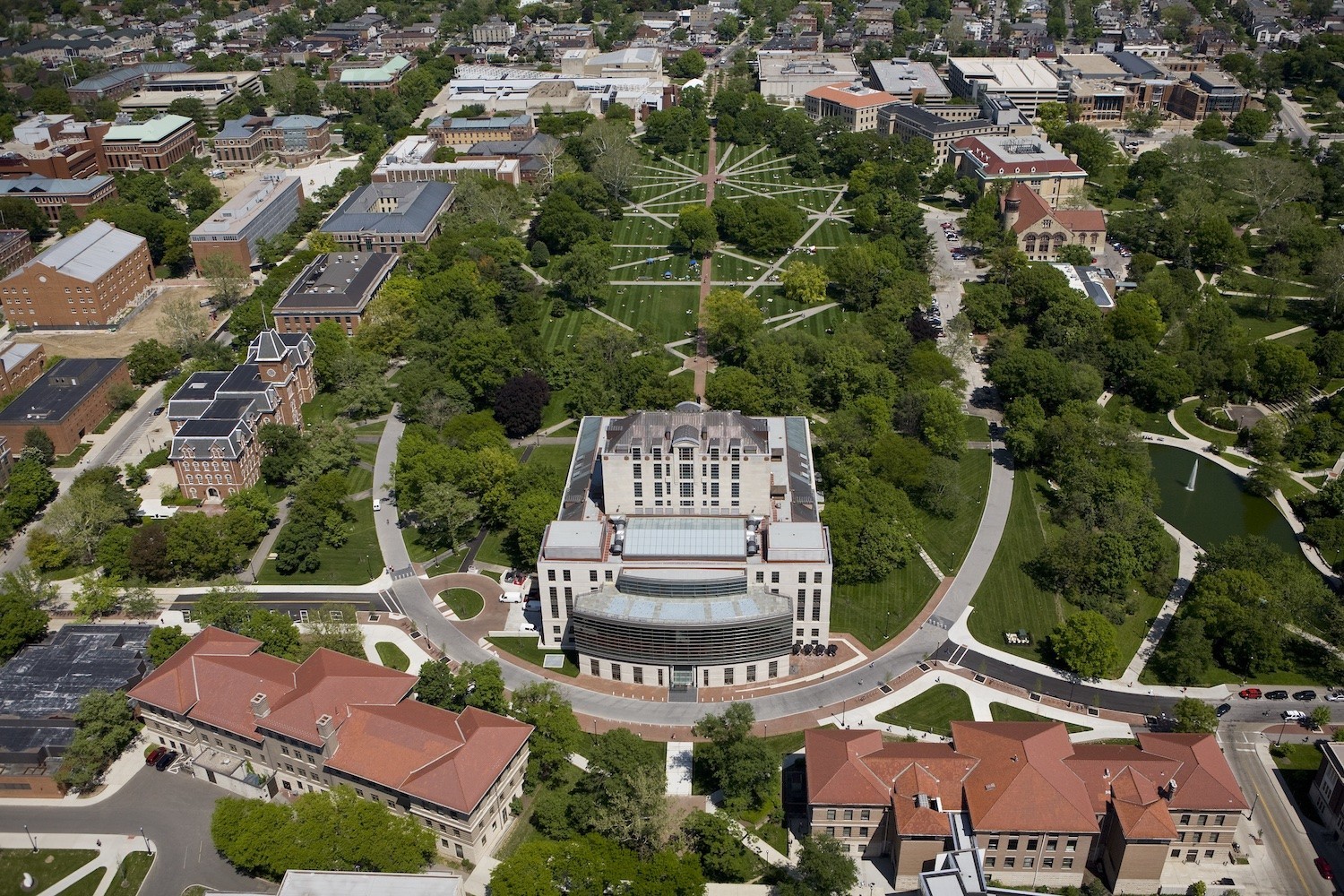
An aerial view of the William Oxley Thompson Memorial Library and The Oval on the Columbus campus of The Ohio State University.
Credit: The Ohio State University Image source
Fellowship Tracks and Compensation
Under the program's five-year fellowship appointment, recent doctoral graduates spend their first two years in residence at the Reagan Institute in Washington, D.C., with a stipend and research funds to complete a first book or major project. Participants then serve a three-year faculty appointment at a partner university, taking part in the academic life of their host department.
Postdoctoral fellows receive an $80,000 annual salary during their two-year Washington residency and a minimum annual salary of $90,000 during their three-year university appointment. Fellows who complete their Washington residency and subsequently accept a tenure-track appointment become eligible for a $250,000 faculty development grant.
Under the three-year graduate fellowship appointment, doctoral candidates in their final year spend one year in residence at the Reagan Institute completing their dissertations, followed by a two-year postdoctoral appointment at a partner university. Graduate fellows receive a $60,000 annual salary during their Washington residency and a minimum annual salary of $75,000 during their two-year university appointment.
Fellows are selected by a committee of faculty representatives from each partner university, based on scholarly merit and a commitment to research that enriches intellectual diversity in their field. The society will also appoint senior fellows from partner institutions to serve as mentors to early fellows and graduate fellows. Senior fellows are invited directly by the institute and may co-teach with fellows and graduate fellows.
University Leadership and Academic Goals
Ohio State officials and Reagan Institute leaders framed the partnership as a response to postdoctoral career hurdles in higher education. Anthony Eames, the Jill Kent Chair in History, Civics, and Statecraft at the Reagan Institute, said the program offers a structured path from dissertation to faculty appointment because resources needed to complete serious scholarship are increasingly difficult to secure. Roger Zakheim, Washington director of the institute, said the society invests in intellectual pluralism by providing opportunities for rising scholars to refine ideas within and beyond the university.
Ohio State Interim Executive Vice President and Provost Trevor Brown welcomed the partnership, saying it offers an exciting opportunity for early career scholars pursuing early research and discovery. Chase Center Executive Director Lee Strang said the center will be a welcome home for new fellows, providing resources and mentorship in fields of study critical to civic life.
Statutory Authority and Faculty Governance
Under state law, the Salmon P. Chase Center for Civics, Culture, and Society is established as an independent academic unit within Ohio State to conduct teaching and research in the historical ideas, traditions, and texts that have shaped the American constitutional order and society. The statutory framework for the center was enacted under House Bill 33 in October 2023. State lawmakers subsequently amended the statute under House Bill 96 in September 2025.
State law grants the center authority to house tenure-track faculty holding appointments within the center, mandating that not fewer than 15 tenure-track faculty positions be allotted to teach under the unit. Under the statute, faculty appointed to the center are not required to hold joint appointments in other university divisions, and no faculty outside of the center possess the authority to block faculty hires into the center.
The center's director holds sole and exclusive authority to manage recruitment and hiring, extend employment offers to all faculty and staff, and develop and approve curriculum, degrees, and general education courses. The board of trustees of the university appoints, with the advice and consent of the senate, a seven-member Chase Center academic council. State law also requires Ohio State to provide adequate space for the center and bars the university from charging overhead or indirect fees, costs, or expenses to the unit.
Previously, Pique Media reported Luke Perez resigned from Ohio State faculty following a campus altercation.
How we know this
The sources and records behind this story, with the facts they support.
Chase Center partners with Reagan Institute to support early career scholars
Supporting evidence (15)
The Ohio State University has joined the Ronald Reagan Presidential Foundation and Institute to launch a multiyear early career fellowship program intended to establish a direct pathway toward tenure-track positions.
Read supporting passage
The Ohio State University has partnered with the Ronald Reagan Presidential Foundation and Institute to help launch the Reagan Institute Society of Fellows, a multiyear fellowship that provides a new pathway to the tenure track for early career scholars.
Ohio State, through the Salmon P. Chase Center for Civics, Culture, and Society, is a founding partner with four other institutions, including Dartmouth College, George Washington University, the University of Wisconsin–Madison, and Vanderbilt University.
Read supporting passage
Ohio State, through the Salmon P. Chase Center for Civics, Culture, and Society, is a founding partner with four other institutions, including Dartmouth College, George Washington University, the University of Wisconsin–Madison and Vanderbilt University.
The society is accepting applications for its inaugural cohort of fellows, with appointments scheduled to begin Sept. 1, 2027.
Read supporting passage
The society is now accepting applications for its inaugural cohort of fellows, with appointments beginning on Sept. 1, 2027.
The society supports eligible scholars focused on five core fields: U.S. political history, America in the world, civic thought, science and technology studies, and law and economics.
Read supporting passage
The society gives scholars time and support to finish their first major work. Eligible scholars are focused on U.S. political history, America in the world, civic thought, science and technology studies, and law and economics. Applicants from any accredited doctoral program are eligible.
Under the program's five-year fellowship appointment, recent doctoral graduates spend their first two years in residence at the Reagan Institute in Washington, D.C., with a stipend and research funds to complete a first book or major project.
Read supporting passage
Five-Year Fellowship Appointment: Fellows are recent PhDs who will spend two years in residence at the Reagan Institute in Washington, D.C., with a stipend and research funds to complete a first book or major project.
Participants then serve a three-year faculty appointment at a partner university, taking part in the academic life of their host department.
Read supporting passage
Fellows then serve a three-year faculty appointment at a partner university, taking part in the life of their host department.
Postdoctoral fellows receive an $80,000 annual salary during their two-year Washington residency and a minimum annual salary of $90,000 during their three-year university appointment.
Read supporting passage
Fellows receive an $80,000 annual salary during their two-year Washington residency and a $90,000 minimum annual salary during the three-year university appointment.
Under the three-year graduate fellowship appointment, doctoral candidates in their final year spend one year in residence at the Reagan Institute completing their dissertations, followed by a two-year postdoctoral appointment at a partner university.
Read supporting passage
Three-Year Graduate Fellowship Appointment: Graduate Fellows are doctoral candidates in their final year who spend one year in residence at the Reagan Institute completing their dissertation, followed by a two-year postdoctoral appointment at a partner university.
Graduate fellows receive a $60,000 annual salary during their Washington residency and a minimum annual salary of $75,000 during their two-year university appointment.
Read supporting passage
Graduate fellows receive a $60,000 annual salary during their one-year Washington residency and a $75,000 minimum annual salary during their two-year university appointment.
Fellows are selected by a committee of faculty representatives from each partner university, based on scholarly merit and a commitment to research that enriches intellectual diversity in their field.
The society will also appoint senior fellows from partner institutions to serve as mentors to early fellows and graduate fellows.
Read supporting passage
The society will also appoint senior fellows from partner institutions who will serve as mentors to early fellows and graduate fellows. The society will further support graduate students with opportunities for research grants throughout their early careers.
Anthony Eames, the Jill Kent Chair in History, Civics, and Statecraft at the Reagan Institute, said the program offers a structured path from dissertation to faculty appointment because resources needed to complete serious scholarship are increasingly difficult to secure.
Read supporting passage
“The academy loses too many of its most promising minds in the years immediately following the PhD. Not for lack of talent or ambition, but because the time and resources needed to complete serious scholarship are increasingly difficult to secure,” said Anthony Eames, the Jill Kent Chair in History, Civics, and Statecraft at the Ronald Reagan Institute. “This program offers a well-funded, structured path from dissertation to faculty appointment.”
Roger Zakheim, Washington director of the institute, said the society invests in intellectual pluralism by providing opportunities for rising scholars to refine ideas within and beyond the university.
Read supporting passage
“President Reagan believed America’s dynamism depended on the vigorous competition of ideas,” said Roger Zakheim, Washington director of the institute. “The Society of Fellows invests in this competition by providing opportunities for a rising generation of scholars to refine their ideas within and beyond the university. We are proud to partner with seven institutions that share our conviction that the pursuit of intellectual pluralism makes universities better for scholars and students alike.”
Ohio State Interim Executive Vice President and Provost Trevor Brown welcomed the partnership, saying it offers an exciting opportunity for early career scholars pursuing early research and discovery.
Read supporting passage
“This partnership offers an exciting opportunity for scholars at a foundational point in their career as they pursue early research and discovery,” said Ohio State’s Interim Executive Vice President and Provost Trevor Brown. “Ohio State and the Chase Center look forward to working with the Ronald Reagan Presidential Foundation and Institute to support our early career scholars.”
Chase Center Executive Director Lee Strang said the center will be a welcome home for new fellows, providing resources and mentorship in fields of study critical to civic life.
Read supporting passage
“This fellowship program focuses on fields of study that are critical to our civic life. The Chase Center will be a welcome home for new Reagan Institute Society of Fellows at Ohio State,” said Chase Center Executive Director Lee Strang. “This program provides both resources and, just as importantly, the valuable mentorship that young scholars need as they begin the next step in their academic career.”
Supporting evidence (2)
Fellows who complete their Washington residency and subsequently accept a tenure-track appointment become eligible for a $250,000 faculty development grant.
Read supporting passage
Following their Washington residency, fellows become eligible for a $250,000 faculty development grant upon the acceptance of a tenure track position.
Senior fellows are invited directly by the institute and may co-teach with fellows and graduate fellows.
Read supporting passage
Senior fellows are invited directly by the Reagan Institute, provide mentorship, and may co-teach with fellows and graduate fellows.
https://codes.ohio.gov/ohio-revised-code/section-3335.39
Supporting evidence (8)
Under state law, the Salmon P. Chase Center for Civics, Culture, and Society is established as an independent academic unit within Ohio State to conduct teaching and research in the historical ideas, traditions, and texts that have shaped the American constitutional order and society.
Read supporting passage
(A)(1) The Salmon P. Chase center for civics, culture, and society is established as an independent academic unit within the Ohio state university. The center shall conduct teaching and research in the historical ideas, traditions, and texts that have shaped the American constitutional order and society.
The statutory framework for the center was enacted under House Bill 33 in October 2023.
Read supporting passage
October 3, 2023 – Enacted by House Bill 33 - 135th General Assembly
State lawmakers subsequently amended the statute under House Bill 96 in September 2025.
Read supporting passage
September 30, 2025 – Amended by House Bill 96 - 136th General Assembly
State law grants the center authority to house tenure-track faculty holding appointments within the center, mandating that not fewer than 15 tenure-track faculty positions be allotted to teach under the unit.
Read supporting passage
(B)(1) The center shall be an independent academic unit with the authority to house tenure-track faculty who hold their appointments within the center. Faculty appointed to the center shall not be required, but may, hold joint appointments within any other division of the university. Not fewer than fifteen tenure-track faculty positions shall be allotted to teach under the center. No faculty outside of the center shall have the authority to block faculty hires into the center.
Under the statute, faculty appointed to the center are not required to hold joint appointments in other university divisions, and no faculty outside of the center possess the authority to block faculty hires into the center.
Read supporting passage
(B)(1) The center shall be an independent academic unit with the authority to house tenure-track faculty who hold their appointments within the center. Faculty appointed to the center shall not be required, but may, hold joint appointments within any other division of the university. Not fewer than fifteen tenure-track faculty positions shall be allotted to teach under the center. No faculty outside of the center shall have the authority to block faculty hires into the center.
The center's director holds sole and exclusive authority to manage recruitment and hiring, extend employment offers to all faculty and staff, and develop and approve curriculum, degrees, and general education courses.
Read supporting passage
(3) The director shall have the sole and exclusive authority to manage the recruitment and hiring process and to extend offers for employment for all faculty and staff, and to terminate employment of all staff. The director shall oversee, develop, and approve the center's curriculum, including approval of the center's courses that meet the university's general education requirements. The center shall be granted the authority to offer courses and develop certificate, minor, and major programs as well as graduate programs, and offer degrees.
The board of trustees of the university appoints, with the advice and consent of the senate, a seven-member Chase Center academic council.
Read supporting passage
(D)(1) The board of trustees of the university shall appoint, with the advice and consent of the senate, a seven-member Chase center academic council. An initial member shall not begin service until confirmed by the senate. Four members shall form a quorum.
State law also requires Ohio State to provide adequate space for the center and bars the university from charging overhead or indirect fees, costs, or expenses to the unit.
Read supporting passage
(2) The university shall provide adequate and appropriate space for the center as jointly determined by the director and either the president or provost of the university. The university shall not charge or assess overhead or indirect fees, costs, expenses, or charges to the center.
Luke Perez Resigns From Ohio State Faculty Following Campus Altercation
Supporting evidence (1)
Previously, Pique Media reported Luke Perez resigned from Ohio State faculty following a campus altercation.
Read supporting passage
Luke Perez Resigns From Ohio State Faculty Following Campus Altercation