Columbus City Schools Unveils Multi-Year Consolidation Plan to Address $50 Million Deficit
District leaders outline two phases of building closures and program moves alongside potential busing cuts to close a $50 million deficit before a December board vote.
Columbus City Schools leadership unveiled an expansive multi-year facility consolidation and operational downsizing proposal on Oct. 12, outlining plans to close or repurpose several schools and trim services to resolve an impending financial crisis.
Speaking at an "Empower Your Voice" community town hall at the Fort Hayes Performing Arts Theatre, Superintendent Angela Chapman and Chief of Strategy and Performance Russell Brown detailed measures designed to eliminate an anticipated $50 million operational deficit. District officials stressed that the recommendations remain proposals subject to public review, with no formal school board action taken yet.
"No one should hear a proposed change tonight and mistake it for a final board vote," Brown said.
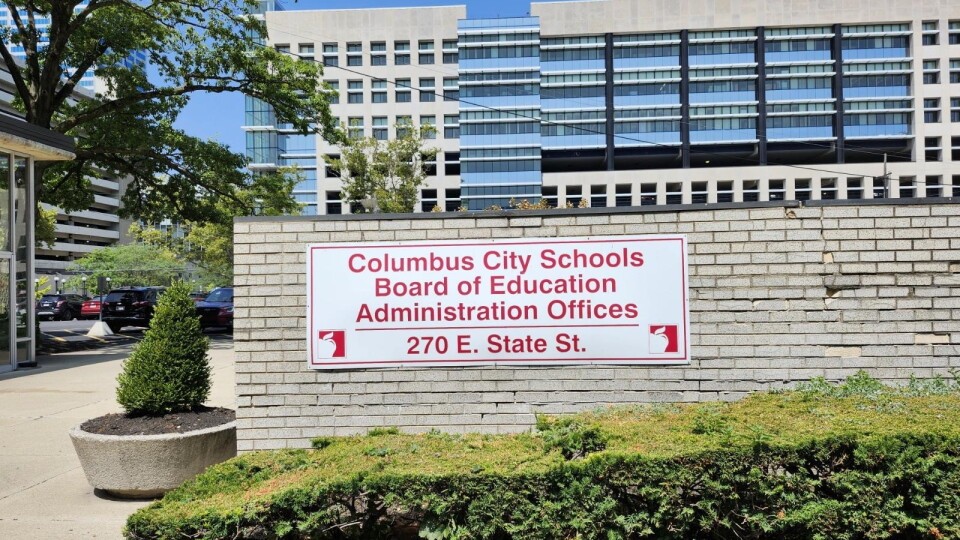
Signage outside the Columbus City Schools Board of Education administrative offices on East State Street in downtown Columbus.
Credit: Allie Vugrincic / WOSU Image source
Deficit Pressures and 13,000 Surplus Seats
The district faces mounting budget pressures as post-pandemic federal relief winds down and routine expenditures outstrip revenues. Chapman noted that Columbus City Schools has drawn on its operating reserves over the past two years to cover day-to-day operations. District financial projections indicate those reserve funds could run dry by 2030 without significant structural spending cuts. Between 2025 and 2027, the district trimmed roughly $67.5 million through central office reductions, non-personnel cutbacks, and initial school closures.
"We had to identify our first $50 million in reductions, and now we’re facing another $50 million in cuts," Chapman said.
Compounding the budget deficit is a significant mismatch between classroom infrastructure and student enrollment. Columbus City Schools currently maintains 109 academic buildings containing roughly 57,000 seats, while actual district enrollment stands at 44,056 students. That imbalance leaves approximately 13,000 vacant seats and an overall districtwide building utilization rate of about 77%, with some individual schools operating at under 30% capacity. District officials argued that consolidating buildings allows resources to be concentrated rather than spread thin across half-empty sites, noting that larger schools do not mean larger class sizes.
External legislative pressure from the Ohio Statehouse has also accelerated consolidation discussions. Under Ohio Senate Bill 311, which has passed the Ohio Senate and was introduced in the House, school districts could face state mandates to dispose of facilities operating at under 60% capacity at below-market value.
Phase 1: Proposed Changes for 2027–2028
The administration presented its facility realignment in two sequential waves. The first phase, proposed for implementation in the 2027–2028 school year, includes:
- Single-Gender Preparatory Schools: Closing Columbus City Preparatory School for Girls and Columbus City Preparatory School for Boys, which together serve fewer than 300 students. Under the plan, Columbus Gifted Academy would move into the Franklin Middle School building, which currently houses the girls prep school. Adult and Community Education and the district Support Center would relocate to the Eastmoor Middle School site, generating an estimated $4.1 million in savings.
- Duxberry Park Arts Elementary: Merging the Duxberry Park Arts Impact Elementary program into Sullivant Elementary to save approximately $1.2 million, alongside boundary adjustments for Sullivant and Avondale elementaries. Officials described this step as an interim measure ahead of a future permanent arts pathway at Fort Hayes.
- Siebert Elementary: Closing the German Village-area school, where district data shows fewer than 50 students live in the neighborhood and fewer than 20 attend, and reassigning students to Stewart and Southwood elementaries.
- Highland Elementary: Ending regular school operations at the 1895 building, which operates at 60.2% utilization, and sending students to West Mound and Burroughs elementaries. The Highland building would then serve as temporary swing space for West Broad Elementary students while a new West Broad facility is built.
Phase 2: High School and Middle School Reshuffle for 2028–2029
The second phase, targeted for the 2028–2029 school year, concentrates on secondary schools across several quadrants:
- Columbus Alternative High School (CAHS): Relocating CAHS from its McGuffey facility into Columbus Downtown High School, a move estimated to save $3.3 million while integrating career-oriented pathways under the district's academy structure.
- South Side Merger: Combining South High School and Marion-Franklin High School at the Marion-Franklin campus, preserving the location for a planned new South Side high school. Buckeye Middle School students and South Side sixth-graders would transition into the South High building, generating about $3.2 million in projected savings.
- Mifflin Realignment: Closing the aged Mifflin Middle School facility and repurposing Mifflin High School to serve middle school and Area STEM students in grades six through eight, yielding an estimated $3.7 million in savings.
Transportation Reductions
District officials are also evaluating transportation reductions. Columbus City Schools currently budgets approximately $70 million annually to bus more than 32,000 students across 39,000 daily route miles.
Under one scenario outlined by administrators, the district would eliminate yellow bus transportation for most high school students, yielding an estimated $6.5 million in direct operational savings while curtailing state fines associated with high school routing non-compliance.
Community Feedback and December Vote Timeline
Even if all proposed facility consolidations and transportation reductions are adopted, district officials estimated they would generate roughly $19.5 million in savings, leaving more than $30 million in additional department and operational cuts to be identified.
Superintendent Chapman and board members underscored that the proposals will undergo extensive public review. The district begins community feedback sessions, focus groups, and surveys on Oct. 14, continuing outreach through November.
The Columbus Board of Education is scheduled to deliberate on the package through autumn public hearings before holding a final vote on school closures, program moves, and budget reductions in December 2026.
Video 0:39
How we know this
The sources and records behind this story, with the facts they support.
Supporting evidence (15)
Speaking at an "Empower Your Voice" community town hall at the Fort Hayes Performing Arts Theatre, Superintendent Angela Chapman and Chief of Strategy and Performance Russell Brown detailed measures designed to eliminate an anticipated $50 million operational deficit.
Read supporting passage
The Columbus Board of Education has directed the administration to identify at least $50 million in operational reductions for the upcoming school year, and this is far from the first round of cuts.
"No one should hear a proposed change tonight and mistake it for a final board vote," Brown said.
Read supporting passage
“No one should hear a proposed change tonight and mistake it for a final board vote,” Brown said.
District financial projections indicate those reserve funds could run dry by 2030 without significant structural spending cuts.
Read supporting passage
District officials said those reserves are shrinking and could run dry by 2030 without more reductions.
"We had to identify our first $50 million in reductions, and now we’re facing another $50 million in cuts," Chapman said.
Read supporting passage
“We had to identify our first $50 million in reductions, and now we’re facing another $50 million in cuts,” she said.
Columbus City Schools currently maintains 109 academic buildings containing roughly 57,000 seats, while actual district enrollment stands at 44,056 students.
Read supporting passage
CCS oversees 109 academic facilities with approximately 57,000 student seats, but current enrollment is 44,056. That leaves roughly 13,000 surplus seats and puts districtwide building utilization at about 77%.
District officials argued that consolidating buildings allows resources to be concentrated rather than spread thin across half-empty sites, noting that larger schools do not mean larger class sizes.
Read supporting passage
“Larger schools do not mean larger class sizes,” Brown said.
Under the plan, Columbus Gifted Academy would move into the Franklin Middle School building, which currently houses the girls prep school.
Read supporting passage
Columbus Gifted Academy would move into the Franklin Middle School building, which currently houses the girls preparatory school, while Adult & Community Education and the district’s Support Center would move into the Eastmoor Middle School building
Duxberry Park Arts Elementary: Merging the Duxberry Park Arts Impact Elementary program into Sullivant Elementary to save approximately $1.2 million, alongside boundary adjustments for Sullivant and Avondale elementaries.
Read supporting passage
Another proposal would merge the Duxberry Park Arts Impact Elementary program into Sullivant Elementary for the 2027-28 school year.
Siebert Elementary: Closing the German Village-area school, where district data shows fewer than 50 students live in the neighborhood and fewer than 20 attend, and reassigning students to Stewart and Southwood elementaries.
Read supporting passage
fewer than 50 students live in the Siebert neighborhood and fewer than 20 of those students currently attend the school.
Highland Elementary: Ending regular school operations at the 1895 building, which operates at 60.2% utilization, and sending students to West Mound and Burroughs elementaries.
Read supporting passage
Highland is currently 60.2% utilized, according to the district, and the building dates all the way back to 1895. Under the proposal, the Highland building would then become the temporary home for West Broad Elementary students while CCS builds a new West Broad Elementary.
Columbus Alternative High School (CAHS): Relocating CAHS from its McGuffey facility into Columbus Downtown High School, a move estimated to save $3.3 million while integrating career-oriented pathways under the district's academy structure.
Read supporting passage
Columbus Alternative High School would move from the McGuffey facility into Columbus Downtown High School.
South Side Merger: Combining South High School and Marion-Franklin High School at the Marion-Franklin campus, preserving the location for a planned new South Side high school.
Read supporting passage
Buckeye Middle School students, along with South Side sixth-graders, would move into a South Side middle school housed at the current South High School building. At the high school level, South High School and Marion-Franklin High School would come together at the Marion-Franklin site.
Mifflin Realignment: Closing the aged Mifflin Middle School facility and repurposing Mifflin High School to serve middle school and Area STEM students in grades six through eight, yielding an estimated $3.7 million in savings.
Read supporting passage
The current middle school building would close, and Mifflin High School would stop operating as a high school. The high school building would then become the new home for Mifflin Middle School students in grades six through eight, along with Area STEM students in those grades.
Under one scenario outlined by administrators, the district would eliminate yellow bus transportation for most high school students, yielding an estimated $6.5 million in direct operational savings while curtailing state fines associated with high school routing non-compliance.
Read supporting passage
One option would reduce district-provided transportation for most high school students. CCS estimates that change would save $6.5 million
The district begins community feedback sessions, focus groups, and surveys on Oct. 14, continuing outreach through November.
Read supporting passage
CCS plans to keep discussing the options during committee and full Board of Education meetings throughout October, November, and December.
Supporting evidence (2)
Under Ohio Senate Bill 311, which has passed the Ohio Senate and was introduced in the House, school districts could face state mandates to dispose of facilities operating at under 60% capacity at below-market value.
Read supporting passage
If Senate Bill 311 passes, the district said the state could force CCS to sell buildings that are less than 60% full for less than the properties are worth. The bill has cleared the state Senate and was introduced in the House.
Single-Gender Preparatory Schools: Closing Columbus City Preparatory School for Girls and Columbus City Preparatory School for Boys, which together serve fewer than 300 students.
Read supporting passage
The district said the two programs serve less than 300 students total.