
Columbus Backs Grant Bid to Bring AI Tools to Participatory Budgeting
Columbus City Council endorsed One Project's application to a $50 million foundation initiative to expand civic budgeting technology.
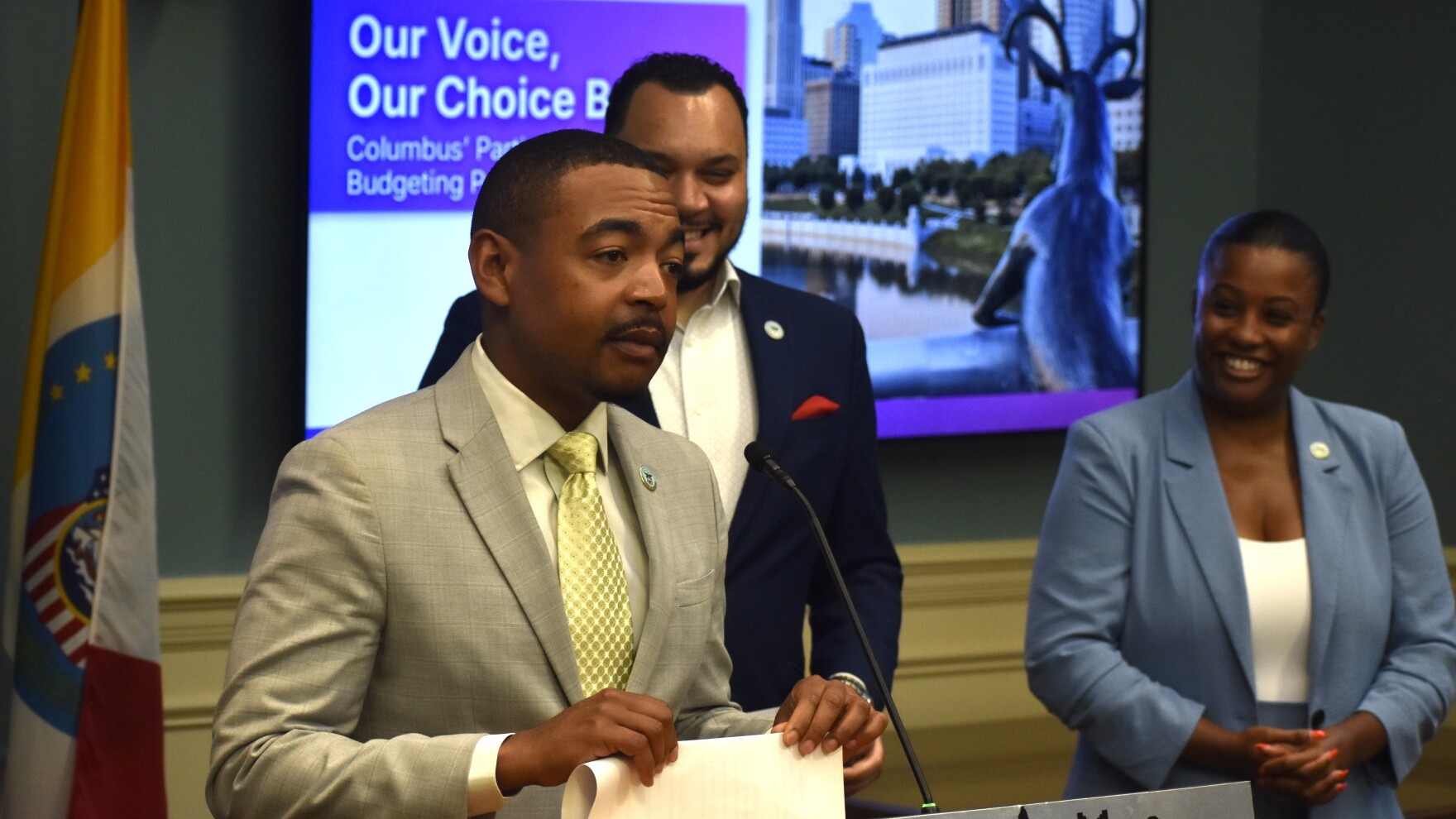
Columbus City Council President Shannon Hardin speaks at a press conference announcing the 'Our Voice, Our Choice' participatory budgeting initiative alongside Councilmembers Nicholas Bankston and Tiara Ross.
Credit: WOSU Public Media Image source
Columbus City Council resolved to support One Project in its grant application to the Rockefeller Foundation as part of the foundation's $50 million Cities Deliver call for proposals. The resolution authorizes Council President Shannon Hardin and Councilmember Nick Bankston to sign a letter of intent committing the city to work alongside One Project if funding is awarded.
The Rockefeller Foundation and OpenAI Foundation launched the $50 million Cities Deliver initiative to support organizations helping cities use artificial intelligence to meet resident needs. Grants under the program range from $500,000 to $2 million per project. Under the call's civic engagement focus, eligible solutions include participatory decision-making, while excluding projects related to voting or elections. According to program materials, applications close on Nov. 29.
Council records state that One Project developed the proposal to enhance the process for future iterations of Columbus's participatory budgeting. The Our Voice, Our Choice Budget gives community members direct access to propose ideas for how to spend $9 million of the city's capital budget.
Previously, Pique Media reported on Oct. 29 that Columbus advanced participatory budgeting ballots for a $9 million capital vote.
Volunteer budget delegates are reviewing proposals that passed initial review to craft a ballot of projects for each district. Between July 6 and Aug. 28, the city received more than 750 project proposals from residents, which administration staff evaluated for cost, capital eligibility, and timeline. Anyone over the age of 16 is invited to participate in the final vote when voting opens in January.
Each funded solution must include a frontier artificial intelligence component using recent models to complete complex tasks. City governments face significant barriers to adopting artificial intelligence, including high implementation costs and uncertainty around data protection.
Video Watch video 0:45
Pique’s reporting on the same events, newest first.
Columbus Latest You are reading
Columbus Backs Grant Bid to Bring AI Tools to Participatory Budgeting
Columbus
Columbus Advances Participatory Budgeting Ballots for $9 Million Capital Vote
Volunteer delegates and paid facilitators are shaping project ballots for a public vote in early 2027 after screening hundreds of resident proposals.
How we know this
The sources and records behind this story, with the facts they support.
Supporting evidence (3)
Columbus City Council resolved to support One Project in its grant application to the Rockefeller Foundation as part of the foundation's $50 million Cities Deliver call for proposals.
Read supporting passage
Section 1. That this Council does hereby express its intention to support One Project in its grant application to the Rockefeller Foundation as part of the Foundation’s $50 million “Cities Deliver: AI Solutions for Public Services” call for proposals, and that following the successful awarding of a grant, Columbus City Council intends to work in partnership with One Project on the execution of the proposal.
The resolution authorizes Council President Shannon Hardin and Councilmember Nick Bankston to sign a letter of intent committing the city to work alongside One Project if funding is awarded.
Read supporting passage
Section 2. That following the adoption of this resolution, Council President Hardin and Councilmember Bankston shall execute a letter of intent as required under the terms of the grant application.
Council records state that One Project developed the proposal to enhance the process for future iterations of Columbus's participatory budgeting.
Read supporting passage
WHEREAS, following the initial success of the project proposal phases, the feasibility review phase, and having now entered the ballot creation phase, One Project has developed a proposal to leverage additional technology tools to enhance the process for future iterations; and
Supporting evidence (6)
The Rockefeller Foundation and OpenAI Foundation launched the $50 million Cities Deliver initiative to support organizations helping cities use artificial intelligence to meet resident needs.
Read supporting passage
Today, The Rockefeller Foundation and OpenAI Foundation launched Cities Deliver: AI Solutions for Public Services, a $50 million initiative to support organizations that help cities around the world use artificial intelligence to better anticipate and meet residents’ needs.
Grants under the program range from $500,000 to $2 million per project.
Read supporting passage
Cities Deliver will award grants ranging from $500,000 to $2 million, aiming to reach up to 100 million city residents globally.
Under the call's civic engagement focus, eligible solutions include participatory decision-making, while excluding projects related to voting or elections.
Read supporting passage
Civic engagement. Solutions that help city governments reach residents proactively and respond faster, from two-way service channels to participatory decision-making. Includes digital access and connectivity, court services, and permitting and regulatory processes. Excludes projects related to voting or elections.
According to program materials, applications close on Nov. 29.
Read supporting passage
Applications open on October 14 and close on November 29, 2026.
Each funded solution must include a frontier artificial intelligence component using recent models to complete complex tasks.
Read supporting passage
Each solution must include a meaningful frontier AI component, using recent AI models to complete complex tasks, and may combine these capabilities with existing city tools and systems.
City governments face significant barriers to adopting artificial intelligence, including high implementation costs and uncertainty around data protection.
Read supporting passage
Yet city governments face significant barriers to adopting AI, including high implementation costs and uncertainty around data protection.
https://common.oneproject.org/en/columbus
Supporting evidence (2)
The Our Voice, Our Choice Budget gives community members direct access to propose ideas for how to spend $9 million of the city's capital budget.
Read supporting passage
Our Voice, Our Choice Budget is a process that gives community members direct access to propose ideas for how to spend $9 million of the City's capital budget.
Anyone over the age of 16 is invited to participate in the final vote when voting opens in January.
Read supporting passage
Residents submitted project ideas over the summer, Budget Delegates are developing them into proposals this fall, and voting opens in January. Anyone over the age of 16 is invited to participate in the final vote.
Columbus Advances Participatory Budgeting Ballots for $9 Million Capital Vote
Supporting evidence (1)
Previously, Pique Media reported on Oct. 29 that Columbus advanced participatory budgeting ballots for a $9 million capital vote.
Read supporting passage
Columbus Advances Participatory Budgeting Ballots for $9 Million Capital Vote
Supporting evidence (2)
Volunteer budget delegates are reviewing proposals that passed initial review to craft a ballot of projects for each district.
Read supporting passage
In this next stage, Impact & Equity Review, volunteer budget delegates will review those projects that have advanced through feasibility review to ultimately craft a ballot of projects for their district.
Between July 6 and Aug. 28, the city received more than 750 project proposals from residents, which administration staff evaluated for cost, capital eligibility, and timeline.
Read supporting passage
between July 6th and August 28th of this year, the city received over 750 project proposals from residents. Following completion of the proposal submissions stage, the initiative shifted to feasibility review, wherein administration staff evaluated the project proposals against criteria for cost, capital eligibility, and estimated timeline to determine if projects should advance to the next stage.