
Justice Department Accuses Ohio State Medical School of Admissions Discrimination
Federal investigators allege medical school admissions bypassed normal reviews to favor certain racial groups, while the university denies bias and plans a legal fight.
The U.S. Department of Justice accused the Ohio State University College of Medicine of racial discrimination in admissions, according to findings reported on Oct. 22.
Federal investigators announced investigative findings that the medical school discriminated against white and Asian students in granting admission to its 2023, 2024, and 2025 incoming classes.
According to federal investigators, the medical school's conduct violates federal civil rights law under Title VI of the Civil Rights Act of 1964 and the U.S. Supreme Court's 2023 decision in Students for Fair Admissions versus Harvard, which banned race discrimination in admissions.
University spokesperson Ben Johnson said Ohio State disagrees with the findings and abides by the law, adding that the university will contest the determinations.
"The university is in full compliance with the Supreme Court’s ruling and all federal and state laws and regulations regarding admissions," Johnson said, adding that the College of Medicine does not factor race or any protected class into admissions decisions.
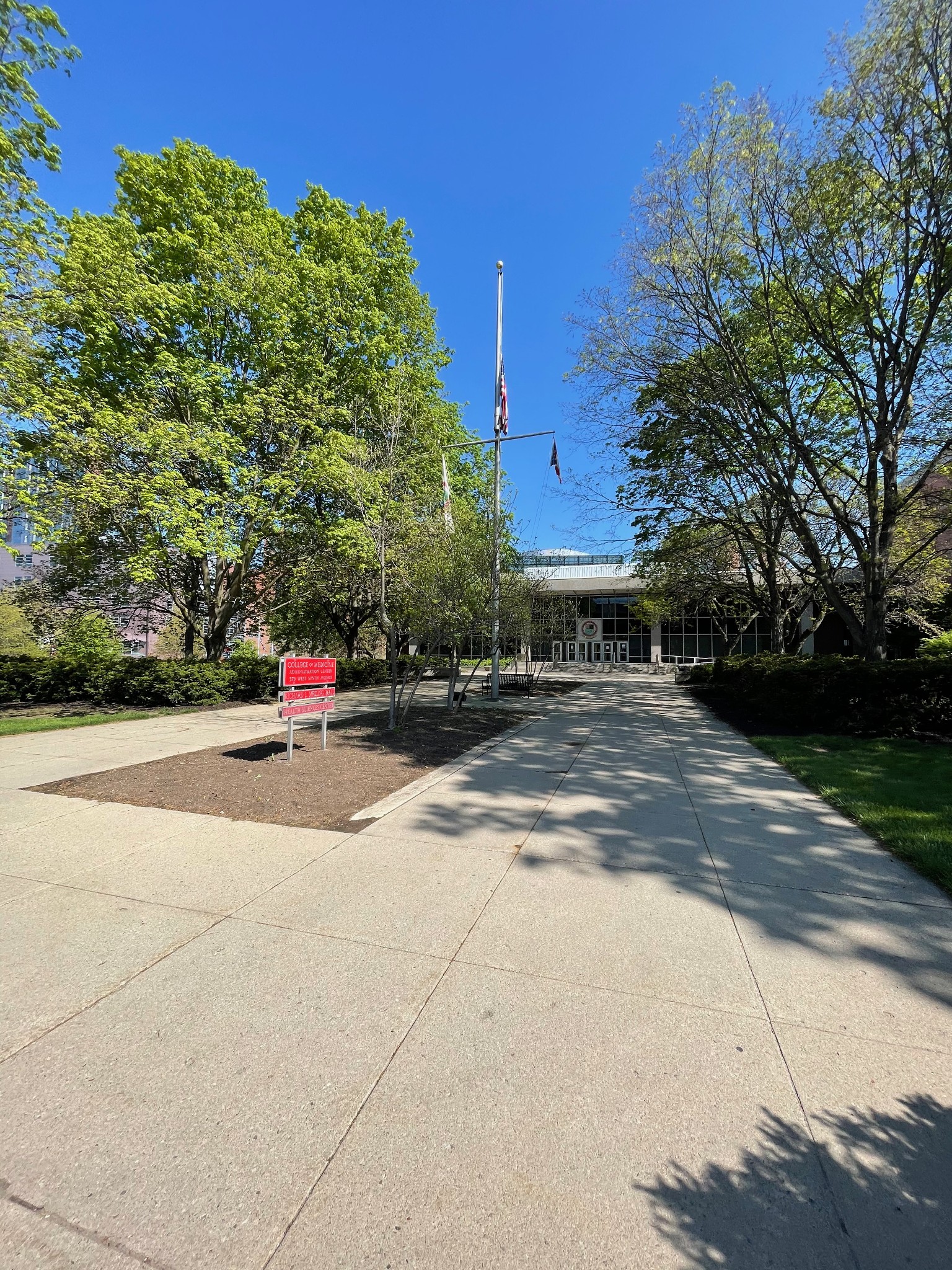
A campus walkway and directory sign lead toward Meiling Hall, administrative headquarters of the Ohio State University College of Medicine in Columbus.
Credit: ChillyBlanket / Wikimedia Commons Image source
Allegations of Unblinded Screeners and 'Side Door' Pathways
According to the Justice Department's findings letter, Ohio State evaluated applicants through a multi-step screening system that relied on reviewers known as screeners. The system scored applicants across three evaluation categories: attributes, with up to 12 points; experiences, with up to 16 points; and academic metrics, with up to 8 points.
According to the findings letter, the medical school blinds certain admissions officers from race and ethnicity data but does not blind the Super Screeners. The Justice Department stated that allowing these reviewers to view racial data enabled race to influence decisions and gave advantages to certain racial groups over others.
Investigators also accused the medical school of operating a "side door" admissions pathway that permitted selected candidates to bypass preliminary screener scoring and skip interviews entirely.
In the 2024 and 2025 entering classes combined, Black applicants admitted through this alternative pathway were four times as likely to gain admission as white applicants, while no Asian applicants were admitted through it, according to federal findings.
Statistical Disparities and Training Materials
Federal officials reported that Black applicants who completed standard screening and interviews were approximately 2.8 times as likely to be admitted as Asian applicants with equivalent credentials.
In the 2025 admissions cycle, Black applicants had 7.7 times higher odds of being invited to interview than Asian applicants with similar academic credentials, and 4.6 times higher odds than comparable white applicants, while Hispanic applicants had 2.3 times higher odds than white or Asian peers, according to the findings letter.
Federal investigators also cited an admissions training retreat presentation delivered by Demicha Rankin, an associate dean and former vice chair for diversity, equity, and inclusion, which outlined committee goals to assemble a class displaying diversity in background and thought using methods adapted from the University of California, Davis. Justice Department officials asserted that those slides promoted racial bias in admissions training by encouraging committee panels to consider race and ethnicity.
Ohio State Pledges to Contest Findings
In a statement released to WOSU, Ohio State emphasized that it strongly disagrees with the findings and maintains full compliance with the Supreme Court's ruling and all federal and state laws.
The compliance review began on March 25, when the Justice Department opened a Title VI civil rights investigation into admissions practices at the medical school.
Assistant Attorney General Harmeet K. Dhillon of the Justice Department's Civil Rights Division stated that all admissions stages must treat applicants equally regardless of race, calling the use of separate processes based on race plainly illegal under federal law.
Federal authorities stated that they plan to seek settlement discussions with Ohio State to bring its medical school into compliance, adding that federal officials will file suit if negotiations fail.
Video Watch video 0:45
How we know this
The sources and records behind this story, with the facts they support.
Supporting evidence (11)
The U.S. Department of Justice accused the Ohio State University College of Medicine of racial discrimination in admissions, according to findings reported on Oct. 22.
Read supporting passage
U.S. Department of Justice accuses Ohio State College of Medicine of admissions discrimination following investigation October 22, 2026Audrey Coleman and Reegan Davis
University spokesperson Ben Johnson said Ohio State disagrees with the findings and abides by the law, adding that the university will contest the determinations.
Read supporting passage
University spokesperson Ben Johnson said Ohio State disagrees with the findings and said that it abides by both federal and state laws.
University spokesperson Ben Johnson said Ohio State disagrees with the findings and abides by the law, adding that the university will contest the determinations.
Read supporting passage
Johnson added that “Ohio State follows the law and will contest these findings.”
"The university is in full compliance with the Supreme Court’s ruling and all federal and state laws and regulations regarding admissions," Johnson said, adding that the College of Medicine does not factor race or any protected class into admissions decisions.
Read supporting passage
“The university is in full compliance with the Supreme Court’s ruling and all federal and state laws and regulations regarding admissions,” Johnson said in an email. “The College of Medicine does not consider race, ethnicity or any other protected class during the admissions process.”
According to the findings letter, the medical school blinds certain admissions officers from race and ethnicity data but does not blind the Super Screeners.
Read supporting passage
“While OSU Medicine blinds certain admissions officers from the race and ethnicity data, it does not blind the Super Screeners,” the findings letter stated.
The Justice Department stated that allowing these reviewers to view racial data enabled race to influence decisions and gave advantages to certain racial groups over others.
Read supporting passage
The college of medicine uses a group of application reviewers, called “super screeners,” which the Department of Justice said allowed race to influence admission decisions due to the fact that they can view race data in an application. The department stated that it believes that this knowledge was used to give certain racial groups advantages over others.
Investigators also accused the medical school of operating a "side door" admissions pathway that permitted selected candidates to bypass preliminary screener scoring and skip interviews entirely.
Read supporting passage
Justice Department officials also accused the college of using a “side door” technique during the screening process that allows applicants to bypass initial screener scores — a number based on MCAT scores, GPA and school list — as well as the interview phase.
In the 2025 admissions cycle, Black applicants had 7.7 times higher odds of being invited to interview than Asian applicants with similar academic credentials, and 4.6 times higher odds than comparable white applicants, while Hispanic applicants had 2.3 times higher odds than white or Asian peers, according to the findings letter.
Read supporting passage
The department found that in 2025, Black applicants had 7.7 times higher odds of going to the interview stage as Asian applicants with similar academic credentials. Similarly, Black applicants had 4.6 times higher odds of being interviewed compared to white applicants with similar academic credentials and Hispanic applicants had 2.3 times higher odds of being interviewed than either white or Asian applicants.
Federal investigators also cited an admissions training retreat presentation delivered by Demicha Rankin, an associate dean and former vice chair for diversity, equity, and inclusion, which outlined committee goals to assemble a class displaying diversity in background and thought using methods adapted from the University of California, Davis.
Read supporting passage
A specific scenario used in the letter details how at an admissions training retreat, the College of Medicine’s Associate Dean, Demicha Rankin, former Vice Chair for Diversity, Equity and Inclusion, presented a slide deck showing the mission of the Admissions Committee is to assemble a class “that displays diversity in background and thought.” According to the slides, OSU Medicine “modified and adopted methodology from UC Davis in their efforts to recruit a diverse class.”
Justice Department officials asserted that those slides promoted racial bias in admissions training by encouraging committee panels to consider race and ethnicity.
Read supporting passage
Dhillon then states in the letter that those slides reflect bias in admission training, encouraging admissions panels to consider race and/or ethnicity in their decisions.
The compliance review began on March 25, when the Justice Department opened a Title VI civil rights investigation into admissions practices at the medical school.
Read supporting passage
The DOJ originally filed the civil rights compliance case on March 25, claiming the college violated Title VI of the Civil Rights Act of 1964, which restricts discrimination based on race, color or country of origin in any program that receives federal funding, per prior Lantern reporting.
Supporting evidence (7)
Federal investigators announced investigative findings that the medical school discriminated against white and Asian students in granting admission to its 2023, 2024, and 2025 incoming classes.
Read supporting passage
The Justice Department’s Civil Rights Division announced today investigative findings that Ohio State University College of Medicine (OSU Med) discriminated against white and Asian students in granting admission to its 2023, 2024, and 2025 incoming classes.
According to federal investigators, the medical school's conduct violates federal civil rights law under Title VI of the Civil Rights Act of 1964 and the U.S. Supreme Court's 2023 decision in Students for Fair Admissions versus Harvard, which banned race discrimination in admissions.
Read supporting passage
OSU Med’s discriminatory conduct violates Title VI of the Civil Rights Act of 1964, which prohibits discrimination based on race or color, and the U.S. Supreme Court’s 2023 decision in Students for Fair Admissions v. Harvard (SFFA), which banned race discrimination in admissions.
The system scored applicants across three evaluation categories: attributes, with up to 12 points; experiences, with up to 16 points; and academic metrics, with up to 8 points.
Read supporting passage
As part of the Holistic Approach, “screeners” score applicants across three scoring categories that have different maximum point values: Attributes (12 max), Experiences (16 max), and Metrics (8 max).
In the 2024 and 2025 entering classes combined, Black applicants admitted through this alternative pathway were four times as likely to gain admission as white applicants, while no Asian applicants were admitted through it, according to federal findings.
Read supporting passage
Using this pathway, in 2024 and 2025 combined, black applicants were four times as likely to be admitted than white applicants, and no Asian applicants were admitted.
Federal officials reported that Black applicants who completed standard screening and interviews were approximately 2.8 times as likely to be admitted as Asian applicants with equivalent credentials.
Read supporting passage
The Department’s investigation found that black applicants who are screened and interviewed are about 2.8 times as likely to be admitted than Asian applicants with equal credentials.
Assistant Attorney General Harmeet K. Dhillon of the Justice Department's Civil Rights Division stated that all admissions stages must treat applicants equally regardless of race, calling the use of separate processes based on race plainly illegal under federal law.
Read supporting passage
said Assistant Attorney General Harmeet K. Dhillon of the Justice Department’s Civil Rights Division. “A university’s admissions process, and all its stages, should apply equally to all applicants regardless of race. The use of a separate admissions process based on race is plainly illegal under federal law, and this Department will not allow these appalling practices to continue at OSU Med or any other federally funded higher ed institution.”
Federal authorities stated that they plan to seek settlement discussions with Ohio State to bring its medical school into compliance, adding that federal officials will file suit if negotiations fail.
Read supporting passage
Where a violation has been found, the Department will engage in settlement negotiations to ensure the school’s admissions practices are brought into compliance. If those efforts fail, the Department will file suit.
Supporting evidence (1)
In a statement released to WOSU, Ohio State emphasized that it strongly disagrees with the findings and maintains full compliance with the Supreme Court's ruling and all federal and state laws.
Read supporting passage
Ohio State released the following statement to WOSU: "Ohio State strongly disagrees with the findings. The university is in full compliance with the Supreme Court's ruling and all federal and state laws and regulations regarding admissions. The College of Medicine does not consider race, ethnicity or any other protected class during the admissions process. Ohio State follows the law and will contest these findings."