
Google and Ohio Power Seek Approval to Upgrade Columbus Lines With Advanced Conductors
Under PUCO Case No. 26-1140-EL-AEC, Google would fund the incremental cost of advanced conductors along 15.5 miles of Columbus-area transmission lines that AEP Ohio Transmission Company plans to rebuild, with PUCO and OPSB approvals still pending.
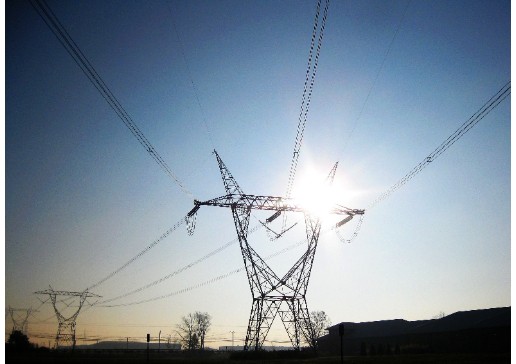
High-voltage transmission lines carry electricity across central Ohio. Google and Ohio Power have proposed installing advanced conductors along 15.5 miles of Columbus-area transmission corridors.
Credit: AEP Ohio · Supplied image Image source
Google and Ohio Power Company announced Nov. 19 that they have proposed a corporate-funded deployment of advanced transmission technologies on central Ohio power lines.
Under a formal joint application filed Nov. 19 under PUCO Case No. 26-1140-EL-AEC, Ohio Power and Cardinal Power LLC, an affiliate of Google LLC, are seeking state approval for a reasonable arrangement termed the Google RA under Ohio utility law. According to the filing, the arrangement serves Google's CLB Data Center load at the Columbus South campus in the Columbus/Lockborne area.
The proposed conductor installation would be integrated into an already planned rebuild by AEP Ohio Transmission Company that, as currently planned, will use traditional ACSS conductors. That underlying project involves rebuilding an existing 14-mile 138-kilovolt transmission line between the Beatty Road Substation in Grove City and the Canal Street Substation near Interstate 71 in downtown Columbus. Under the joint application, the project would replace standard conductors with advanced ACCC conductors across approximately 13.5 miles of the Beatty-Canal line and an additional two miles of the Cyprus-Parsons line, totaling 15.5 miles of advanced conductor work.
Upgrade Costs and Ratepayer Safeguards
In the regulatory filing, Ohio Power and Google stated that Google will fund approximately $10 million as the incremental cost of deploying advanced conductors rather than standard lines. Google is solely responsible for all incremental capital and removal costs, with any subsequent true-up of actual costs paid entirely by Google through contributions in aid of construction remitted to AEP Ohio Transmission Company with a tax gross-up. Initial company announcements on Nov. 19 and Nov. 20 cited a $10.8 million incremental cost for the project, a figure that does not appear in the formal PUCO application.
Addressing consumer impact, the joint filing explicitly states that in no event will any incremental cost of the upgrade be recovered from other customers. The application provides that Cardinal Power will pay all applicable Schedule DCT rates and riders, specifying that the arrangement imposes no costs on other customers, creates no delta revenue, and precludes Ohio Power from seeking recovery of administrative costs from other consumers under state utility rules. The filing also projects that other customers will benefit by retiring existing conductor net plant from the transmission rate base, yielding approximately $33,000 a year in avoided return that would otherwise be collected through transmission rates.
The underlying Beatty Road–Canal Street line replacement remains an already planned AEP Ohio Transmission Company project, and the application does not state that other customers will pay for the base rebuild, nor does it name an Open Access Transmission Tariff, PJM network-service charge, formula rate, or rider as its cost-recovery vehicle.
Grid Capacity and Timeline
Under the joint application, 24 megawatts of previously contracted Second ESA capacity would be accelerated to the fourth quarter of 2028, approximately two years sooner than scheduled. Remaining capacity under that agreement stays on its original schedule, which depends on a planned 300-mile, 765-kilovolt transmission buildout scheduled for 2030 or 2031.
Once that regional transmission project is complete, the upgraded lines are projected to unlock more than 700 megawatts of additional transmission capacity, which will become available through Ohio Power's established queue process to Google or any other load proposing to connect. The filing specifies that other system benefits, including capacity gains and transmission-related revenues, will be used for the benefit of and to reduce costs to retail customers.
In connection with the upgrade, Google has also pledged $1 million toward utility lineman training and manufacturing apprenticeships in Ohio alongside a national advanced-conductor curriculum, with the filing providing no financial breakdown among the three initiatives.
Regulatory Approvals and Contingencies
The joint applicants have requested that the PUCO approve the Google arrangement without modification, though the filing does not establish a comment period or automatic approval deadline under commission rules. The proposed transmission upgrades remain pending regulatory approval from both the PUCO and the Ohio Power Siting Board.
The underlying rebuild project is also pending before the Ohio Power Siting Board under OPSB Case No. 26-73-EL-BTX, with a state board decision anticipated in spring 2027. If the PUCO approves the arrangement, the advanced conductor upgrades will be incorporated into the siting board application, targeting an in-service date no later than the fourth quarter of 2028.
If the upgrade is not constructed for any reason, including if the siting board does not approve it, Google will remain responsible for all incremental costs incurred to that point, with any unspent funds returned to Google.
Video Watch video 0:38
How we know this
The sources and records behind this story, with the facts they support.
Supporting evidence (3)
Google and Ohio Power Company announced Nov. 19 that they have proposed a corporate-funded deployment of advanced transmission technologies on central Ohio power lines.
Read supporting passage
States Google and Ohio Power “have jointly filed a proposal with the Public Utilities Commission of Ohio (PUCO)” for a voluntary corporate-funded deployment of advanced transmission technologies: large users pay the extra cost of advanced, higher-capacity conductors on a line project the utility already has planned, “in a way that strengthens reliability and lowers costs for everyday electricity customers.”
Initial company announcements on Nov. 19 and Nov. 20 cited a $10.8 million incremental cost for the project, a figure that does not appear in the formal PUCO application.
Read supporting passage
Quote: “The $10.8 million incremental cost to complete this work would be funded completely by Google.”
The proposed transmission upgrades remain pending regulatory approval from both the PUCO and the Ohio Power Siting Board.
Read supporting passage
“Pending approval from the PUCO and the Ohio Power Siting Board, the Columbus transmission upgrade is expected to be in service by late 2028.”
Supporting evidence (22)
Under a formal joint application filed Nov. 19 under PUCO Case No. 26-1140-EL-AEC, Ohio Power and Cardinal Power LLC, an affiliate of Google LLC, are seeking state approval for a reasonable arrangement termed the Google RA under Ohio utility law.
Read supporting passage
CONFIRMED: 26-1140-EL-AEC is the Google filing. Caption: Joint Application of Ohio Power Company and Cardinal Power LLC for a Reasonable Arrangement under R.C. 4905.31 and OAC 4901:1-38. Cardinal Power LLC is “an affiliate of Google LLC.” The arrangement is called the “Google RA.” Electronically filed Nov. 19, 2026, 10:31:48 a.m., by Steven T. Nourse for Ohio Power; only document on the docket.
According to the filing, the arrangement serves Google's CLB Data Center load at the Columbus South campus in the Columbus/Lockborne area.
Read supporting passage
Load: Google’s “CLB Data Center” = Columbus South campus in the Columbus/Lockborne area (p. 3).
The proposed conductor installation would be integrated into an already planned rebuild by AEP Ohio Transmission Company that, as currently planned, will use traditional ACSS conductors.
Read supporting passage
The underlying Rebuild Project is a separate, already planned AEP Ohio Transmission Company Beatty Road–Canal Street 138 kV rebuild that, “as currently planned, … will use traditional [ACSS] conductors” (p. 6).
That underlying project involves rebuilding an existing 14-mile 138-kilovolt transmission line between the Beatty Road Substation in Grove City and the Canal Street Substation near Interstate 71 in downtown Columbus.
Read supporting passage
The existing Beatty-Canal line is described as a 14-mile 138 kV line from Beatty Road Substation (Grove City) to Canal Street Substation (near I-71, downtown Columbus), 1960s infrastructure (p. 6).
Under the joint application, the project would replace standard conductors with advanced ACCC conductors across approximately 13.5 miles of the Beatty-Canal line and an additional two miles of the Cyprus-Parsons line, totaling 15.5 miles of advanced conductor work.
Read supporting passage
“Google will fund approximately $10 million” to replace standard ACSR with ACCC on portions of Beatty Road-Canal Street and Cyprus-Parsons 138 kV (pp. 1–2).
Under the joint application, the project would replace standard conductors with advanced ACCC conductors across approximately 13.5 miles of the Beatty-Canal line and an additional two miles of the Cyprus-Parsons line, totaling 15.5 miles of advanced conductor work.
Read supporting passage
LINES / MILES / LOCATION: System Upgrade = “approximately 13.5 miles” of the Beatty-Canal Line (plus associated station equipment) and “an additional two miles” of Cyprus-Parsons, i.e. 15.5 miles total; the filing never writes “15.5” as one figure (p. 7).
In the regulatory filing, Ohio Power and Google stated that Google will fund approximately $10 million as the incremental cost of deploying advanced conductors rather than standard lines.
Read supporting passage
“Google will fund approximately $10 million” to replace standard ACSR with ACCC on portions of Beatty Road-Canal Street and Cyprus-Parsons 138 kV (pp. 1–2).
Google is solely responsible for all incremental capital and removal costs, with any subsequent true-up of actual costs paid entirely by Google through contributions in aid of construction remitted to AEP Ohio Transmission Company with a tax gross-up.
Read supporting passage
“The System Upgrade will have an incremental cost of approximately $10 million, and any subsequent true-up amounts reflecting the final actual incremental costs will be paid entirely by Google.” Google is “solely responsible for all incremental costs … (including capital costs and removal costs),” invoiced via a CIAC, remitted to AEP Ohio Transmission Company with a tax gross-up. True-up: Google pays any overage, is refunded any unused amount (p. 7).
Initial company announcements on Nov. 19 and Nov. 20 cited a $10.8 million incremental cost for the project, a figure that does not appear in the formal PUCO application.
Read supporting passage
The filing does not use the releases’ $10.8 million figure.
Addressing consumer impact, the joint filing explicitly states that in no event will any incremental cost of the upgrade be recovered from other customers.
Read supporting passage
Incremental System Upgrade costs will not be recovered from other customers: “In no event will any incremental cost of the System Upgrade be recovered from other customers” (p. 7); the arrangement “imposes no costs on other customers” and “creates no delta revenue” (p. 2); “There will be no additional ratepayer costs associated with the System Upgrades”
The application provides that Cardinal Power will pay all applicable Schedule DCT rates and riders, specifying that the arrangement imposes no costs on other customers, creates no delta revenue, and precludes Ohio Power from seeking recovery of administrative costs from other consumers under state utility rules.
Read supporting passage
Cardinal Power “will pay all applicable Schedule DCT rates and riders”; “Ohio Power will not seek to recover any delta revenue, administrative costs, or other costs associated with the Google RA from other customers, under OAC 4901:1-38-08” (p. 9).
The filing also projects that other customers will benefit by retiring existing conductor net plant from the transmission rate base, yielding approximately $33,000 a year in avoided return that would otherwise be collected through transmission rates.
Read supporting passage
Ratepayers “will avoid both the capital investment and removal costs associated with the upgrade” and benefit from retiring existing conductor net plant from transmission rate base; about $33 thousand a year in avoided return “that would otherwise be collected through transmission rates” (p. 8; NBV $450,394 as of 9/30/2026, WACC 7.29%, illustration $32,834; “$0 recovered from existing customers” for the customer-funded upgrade and removal).
The underlying Beatty Road–Canal Street line replacement remains an already planned AEP Ohio Transmission Company project, and the application does not state that other customers will pay for the base rebuild, nor does it name an Open Access Transmission Tariff, PJM network-service charge, formula rate, or rider as its cost-recovery vehicle.
Read supporting passage
The underlying Rebuild Project is a separate, already planned AEP Ohio Transmission Company Beatty Road–Canal Street 138 kV rebuild that, “as currently planned, … will use traditional [ACSS] conductors” (p. 6). Google’s funding is the incremental ACCC cost versus that planned standard rebuild (p. 7). The filing does not say other customers will pay the base rebuild, and it does not name an OATT, PJM network-service charge, formula rate, or rider as the recovery vehicle for that base rebuild. Do not guess that path.
Under the joint application, 24 megawatts of previously contracted Second ESA capacity would be accelerated to the fourth quarter of 2028, approximately two years sooner than scheduled.
Read supporting passage
CAPACITY: 24 MW of previously contracted Second ESA / DCT capacity accelerated to “the fourth quarter of 2028 – approximately two years sooner”; remaining Second ESA capacity stays on the original schedule, which depends on the 765 kV New Build (approx. 300 miles, PJM 2025 RTEP / Project 570, Transource (AEP/Evergy) and FirstEnergy Transmission, scheduled 2030/2031) (pp. 2–3, 8–9).
Remaining capacity under that agreement stays on its original schedule, which depends on a planned 300-mile, 765-kilovolt transmission buildout scheduled for 2030 or 2031.
Read supporting passage
remaining Second ESA capacity stays on the original schedule, which depends on the 765 kV New Build (approx. 300 miles, PJM 2025 RTEP / Project 570, Transource (AEP/Evergy) and FirstEnergy Transmission, scheduled 2030/2031) (pp. 2–3, 8–9).
Once that regional transmission project is complete, the upgraded lines are projected to unlock more than 700 megawatts of additional transmission capacity, which will become available through Ohio Power's established queue process to Google or any other load proposing to connect.
Read supporting passage
Once the 765 kV New Build is complete, “an additional 700 MW+ of transmission capacity on the proposed lines” — capacity “that would not have existed under standard ACSR rebuild assumptions” — “will be available based on Ohio Power’s established queue process to the Google load or any other load proposing to connect to the lines” (pp. 5, 9, 13).
The filing specifies that other system benefits, including capacity gains and transmission-related revenues, will be used for the benefit of and to reduce costs to retail customers.
Read supporting passage
Other system benefits, including the 700 MW+ unlock, FTRs/ICTRs/IARRs and associated revenues, “will be used for the benefit of and to reduce costs to retail customers” (p. 9).
In connection with the upgrade, Google has also pledged $1 million toward utility lineman training and manufacturing apprenticeships in Ohio alongside a national advanced-conductor curriculum, with the filing providing no financial breakdown among the three initiatives.
Read supporting passage
WORKFORCE: “Google will provide $1 million in connection with the System Upgrade toward utility lineman training and manufacturing apprenticeships in Ohio,” then describes three initiatives (Ohio lineman training, a national advanced-conductor curriculum, manufacturing apprenticeships) with no dollar split (pp. 11–12).
The joint applicants have requested that the PUCO approve the Google arrangement without modification, though the filing does not establish a comment period or automatic approval deadline under commission rules.
Read supporting passage
Request that the Google RA be “approved without modification”; then an amendment to the Second ESA (p. 14). The filing does not set a comment period or auto-approval deadline under 4901:1-38.
The underlying rebuild project is also pending before the Ohio Power Siting Board under OPSB Case No. 26-73-EL-BTX, with a state board decision anticipated in spring 2027.
Read supporting passage
OPSB Case No. 26-73-EL-BTX (same as 26-0073-EL-BTX); pre-app March 9, 2026; anticipated OPSB decision Spring 2027, construction shortly after; Rebuild in service “no later than the fourth quarter of 2028.”
If the PUCO approves the arrangement, the advanced conductor upgrades will be incorporated into the siting board application, targeting an in-service date no later than the fourth quarter of 2028.
Read supporting passage
anticipated OPSB decision Spring 2027, construction shortly after; Rebuild in service “no later than the fourth quarter of 2028.” If PUCO approves the RA, “the System Upgrade will be incorporated into the OPSB application for the Rebuild Project” (pp. 6 & n.1, 13).
If the upgrade is not constructed for any reason, including if the siting board does not approve it, Google will remain responsible for all incremental costs incurred to that point, with any unspent funds returned to Google.
Read supporting passage
IF NOT BUILT: “If the System Upgrade is not constructed for any reason, including if it is not approved by the [OPSB], Google will remain responsible for all incremental costs incurred to that point, and any unspent funds will be returned to Google.” (p. 7)