
Ohio State Wexner Medical Center Nurses Challenge Incentive Pay Rollout and Seek State Inquiries
Union leaders filed a contract grievance over a unilateral $25-per-hour bonus program and asked state licensing boards to investigate two hospital executives.
The Ohio State University Wexner Medical Center announced Thursday that it is implementing an incentive pay program for nurses. In a news release, the medical center described the rollout as a critical tool to support patient care following increased concerns from nursing units over the prior week. The medical center stated that the new program is scheduled to go into effect at 7 a.m. on Nov. 15.
The Ohio Nurses Association told 10TV that it filed a formal grievance, alleging the medical center's decision to implement the program violates its collective bargaining agreement. The Ohio State University Nurses Organization represents nearly 4,200 nurses. At the same time, the union announced it is preparing formal complaints asking state licensing boards to investigate Dr. John J. Warner, the chief executive officer of the medical center, and Corrin Steinhauer, the chief nursing officer of The James Cancer Hospital.
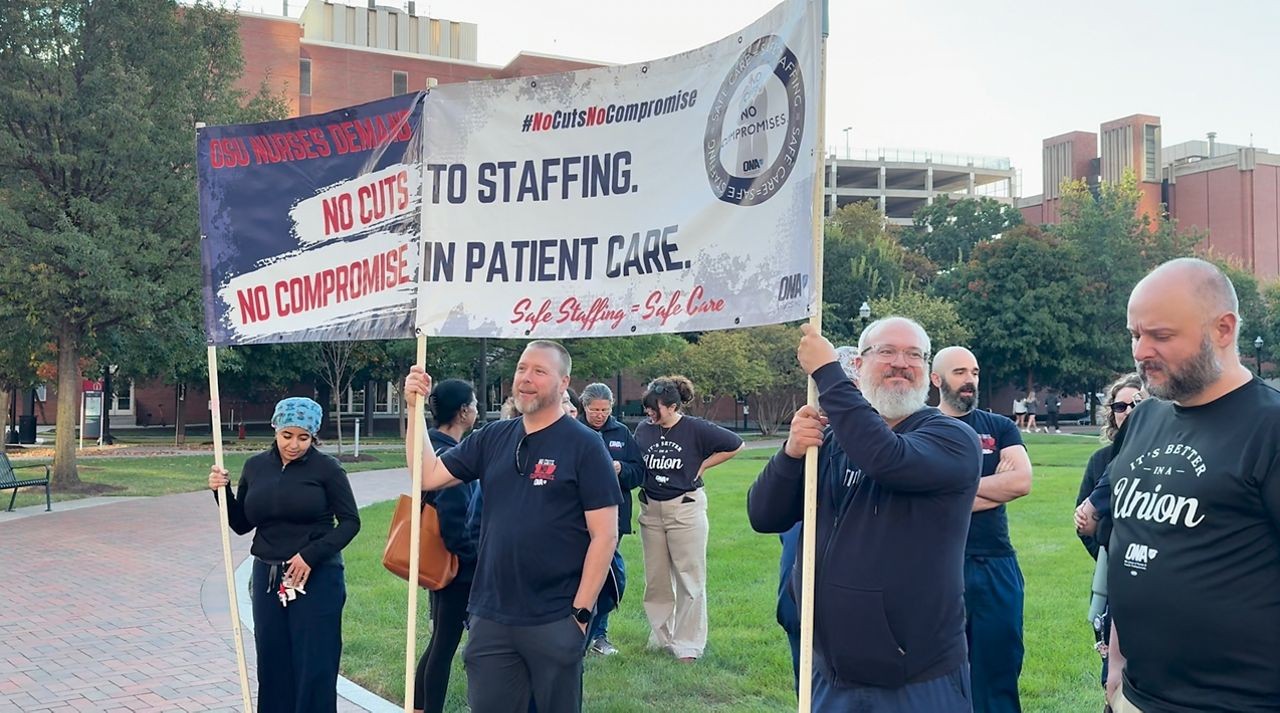
Ohio State University Nurses Organization members demonstrate outside The James Cancer Hospital over staffing and incentive pay concerns.
Credit: Spectrum News 1 / Saima Khan Image source
Contract Grievance and Incentive Pay
In its grievance, the union cited contract language stating that the hospital system may implement incentives for nurses working voluntary extra hours only with the agreement of the union. Union officials said that the medical center's incentive proposal had previously been rejected by 97% of voting members.
The prior incentive program expired on Sept. 30, cutting off extra payments for designated shifts before Ohio State offered an additional $25 an hour for those shifts, below rates that reached $40 an hour during the COVID-19 pandemic. In a letter to hospital administrators, the union asserted that management's actions demonstrate a blatant disregard for the collective bargaining agreement and the nurses whose labor sustains the hospital.
The union demanded that the medical center halt the rollout, adopt the union's counterproposal, make nurses whole for lost wages, and remove the executives responsible from authority over nursing labor relations and staffing decisions.
Hospital Leadership Defends Unilateral Rollout
Hospital leadership stated in a letter that administrators acted given the urgency of patient care needs after being disappointed that they could not reach a collaborative solution on nursing incentive pay. Ohio State Wexner Medical Center noted that the incentive is double the market rate.
The medical center described the rollout as a responsible, sustainable program that expands opportunities to more nurses and empowers unit managers to use it. The medical center added that nurses take on extra shifts when patient care needs fluctuate, stating that moving forward with this program will best serve nurses, patients, and the community. Medical center officials also stated that they would review internal data to verify whether staffing requests had increased or fewer nurses had volunteered for extra shifts.
State Licensing Board Complaints Over Staffing
Beyond the contract grievance, the union's regulatory filings seek state reviews of individual hospital executives over clinical staffing conditions. According to the association, the complaints focus on staffing shortages that have contributed to canceled open-heart surgeries, closed intensive care beds, and limits on patient admissions and transfers.
The union stated that direct-care nurses have repeatedly documented short-staffing and notified executives of escalating risks to patient safety. The association asked the state medical and nursing boards to investigate what Warner and Steinhauer knew, how they responded to warnings, and whether their actions complied with professional standards.
The association also clarified that its complaints are intended to prompt independent investigations rather than presume any findings of wrongdoing. Ohio Nurses Association President Rick Lucas stated that licensed healthcare leaders carry a fundamental responsibility to protect patients that is not excused by an executive title.
The Ohio Nurses Association previously announced a contract on July 3, 2025, calling it a major milestone in the fight for patient safety, workplace protections, and accountability from hospital leadership.
How we know this
The sources and records behind this story, with the facts they support.
https://www.yahoo.com/news/us/articles/nurses-union-files-grievance-ohio-182033354.html
Supporting evidence (12)
The Ohio State University Wexner Medical Center announced Thursday that it is implementing an incentive pay program for nurses.
Read supporting passage
The Ohio State University Wexner Medical Center on Thursday announced it is implementing an incentive pay program for nurses.
In a news release, the medical center described the rollout as a critical tool to support patient care following increased concerns from nursing units over the prior week.
Read supporting passage
"We believe that a strong and sustainable incentive program is one critical tool to support patient care. Following increased concerns from our nursing units over the past week, we are taking this step to ensure our nurses have the support needed to keep giving our patients the very best care," the medical center shared in a news release.
The medical center stated that the new program is scheduled to go into effect at 7 a.m. on Nov. 15.
Read supporting passage
The new program goes into effect at 7 a.m. on Nov. 15.
The Ohio Nurses Association told 10TV that it filed a formal grievance, alleging the medical center's decision to implement the program violates its collective bargaining agreement.
Read supporting passage
Following the announcement, the Ohio Nurses Association told 10TV it filed a formal grievance, alleging the medical center's decision to implement the program violates its collective bargaining agreement.
In its grievance, the union cited contract language stating that the hospital system may implement incentives for nurses working voluntary extra hours only with the agreement of the union.
Read supporting passage
"Article 15 explicitly states: 'The Hospitals may, with the agreement of ONA, implement incentives offered to nurses working voluntary extra hours,'" ONA said.
Union officials said that the medical center's incentive proposal had previously been rejected by 97% of voting members.
Read supporting passage
The union said the proposal was previously rejected by 97% of ONA members.
In a letter to hospital administrators, the union asserted that management's actions demonstrate a blatant disregard for the collective bargaining agreement and the nurses whose labor sustains the hospital.
Read supporting passage
"Management's actions demonstrate a blatant disregard for the collective bargaining agreement, the bargaining process, and the nurses whose labor sustains this institution," ONA stated in a letter addressed to OSU Medical Center Administration.
The union demanded that the medical center halt the rollout, adopt the union's counterproposal, make nurses whole for lost wages, and remove the executives responsible from authority over nursing labor relations and staffing decisions.
Read supporting passage
ONA demands that the medical center cease the implementation of the program and instead implement a proposal from ONA on incentive pay. They also ask that affected bargaining unit nurses be made whole for lost wages and other damages, and that the medical center provide a written acknowledgment of its alleged contract violations. The union also asks that the executives who are responsible for the implementation be removed from authority over nursing labor relations and staffing decisions.
Hospital leadership stated in a letter that administrators acted given the urgency of patient care needs after being disappointed that they could not reach a collaborative solution on nursing incentive pay.
Read supporting passage
"We had hoped to reach a collaborative solution on nursing incentive pay. We're disappointed that didn't happen," the letter stated. "Given the urgency of patient care needs, we are acting now to do what's best for our nurses and our patients."
Ohio State Wexner Medical Center noted that the incentive is double the market rate.
Read supporting passage
Ohio State Wexner Medical Center noted the incentive is double the market rate.
The medical center described the rollout as a responsible, sustainable program that expands opportunities to more nurses and empowers unit managers to use it.
Read supporting passage
"It is a responsible, sustainable program that expands opportunities to more nurses and empowers unit managers to use it," the medical center said.
The medical center added that nurses take on extra shifts when patient care needs fluctuate, stating that moving forward with this program will best serve nurses, patients, and the community.
Read supporting passage
"In any hospital system, nurses take on extra shifts when patient care needs fluctuate and more support is needed. That commitment makes a real difference for our patients, and we believe moving forward with this program will best serve our nurses, our patients and our community."
Supporting evidence (4)
The Ohio State University Nurses Organization represents nearly 4,200 nurses.
The prior incentive program expired on Sept. 30, cutting off extra payments for designated shifts before Ohio State offered an additional $25 an hour for those shifts, below rates that reached $40 an hour during the COVID-19 pandemic.
Read supporting passage
The prior program had expired on Sept. 30, cutting off extra payments for designated shifts, and Ohio State's replacement offer would have provided an additional $25 an hour for those shifts — well below the $40-an-hour rates the earlier program reached during the COVID-19 pandemic.
Medical center officials also stated that they would review internal data to verify whether staffing requests had increased or fewer nurses had volunteered for extra shifts.
Read supporting passage
Ohio State officials said they would need to review data to confirm whether staffing requests had increased or whether fewer nurses were volunteering for extra shifts, Spectrum News 1 reported.
The Ohio Nurses Association previously announced a contract on July 3, 2025, calling it a major milestone in the fight for patient safety, workplace protections, and accountability from hospital leadership.
Read supporting passage
The Ohio Nurses Association announced that contract on July 3, 2025, calling it a major milestone in the fight for patient safety, workplace protections, and accountability from hospital leadership.
Supporting evidence (6)
At the same time, the union announced it is preparing formal complaints asking state licensing boards to investigate Dr. John J. Warner, the chief executive officer of the medical center, and Corrin Steinhauer, the chief nursing officer of The James Cancer Hospital.
Read supporting passage
The Ohio Nurses Association announced it is preparing formal complaints to the State Medical Board of Ohio and the Ohio Board of Nursing concerning John J. Warner, MD, CEO of the medical center, and Corrin Steinhauer, DNP, RN, Chief Nursing Officer of The James Cancer Hospital.
According to the association, the complaints focus on staffing shortages that have contributed to canceled open-heart surgeries, closed intensive care beds, and limits on patient admissions and transfers.
Read supporting passage
The association said the complaints focus on "staffing deficiencies that have reportedly contributed to canceled open-heart surgeries, closed intensive care beds, limitations on patient admissions and transfers" and nursing assignments that are described as increasingly concerning.
The union stated that direct-care nurses have repeatedly documented short-staffing and notified executives of escalating risks to patient safety.
Read supporting passage
ONA says that nurses have raised the alarm on a number of occasions— documenting short-staffing, notifying hospital executives of the risks and demanding immediate action.
The association asked the state medical and nursing boards to investigate what Warner and Steinhauer knew, how they responded to warnings, and whether their actions complied with professional standards.
Read supporting passage
The association is asking the state medical and nursing boards to investigate further into what each executive knew about the situation, what decisions they made, how they responded to repeated safety warnings and whether their actions or omissions complied with applicable professional standards.
The association also clarified that its complaints are intended to prompt independent investigations rather than presume any findings of wrongdoing.
Ohio Nurses Association President Rick Lucas stated that licensed healthcare leaders carry a fundamental responsibility to protect patients that is not excused by an executive title.
Read supporting passage
“These are licensed healthcare professionals who have a fundamental responsibility to protect patients,” ONA President Rick Lucas, BSN, RN, CCRN said in a release. “They have been warned about dangerous conditions, yet patients continue to face unnecessary risks and disruptions in care. An executive title does not excuse anyone from their professional obligations.”