
Ohio Lawmakers Weigh Police Surveillance Guardrails and $7 Million Technology Expansion
House Bill 725 proposes statewide guidelines, felony misuse penalties and public records exemptions as House Bill 817 proposes a $7 million technology expansion.
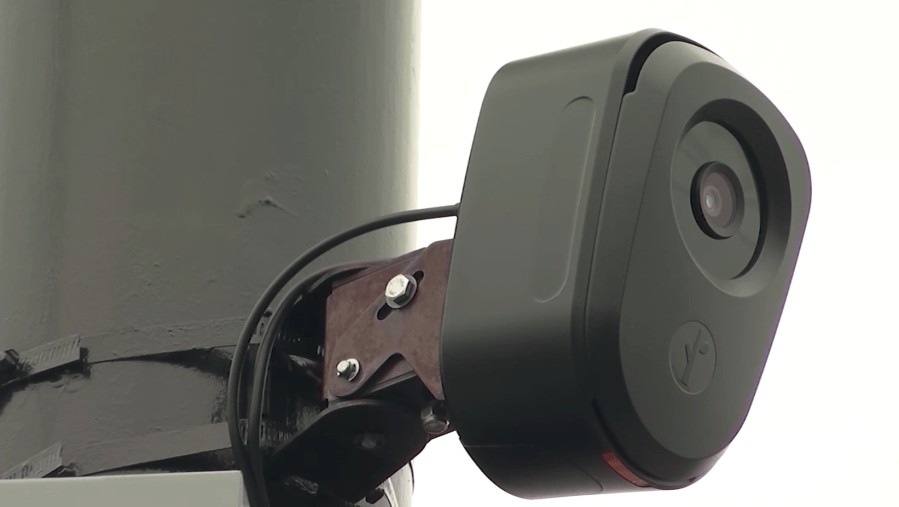
A Flock Safety automated license plate reader camera installed on an outdoor utility pole.
Credit: NBC4 / Nexstar Media Inc. Image source
Ohio lawmakers are weighing a two-pronged legislative push over police surveillance technology, considering statewide operating standards and strict misuse penalties while simultaneously reviewing a multimillion-dollar funding expansion for automated cameras and drones.
The legislative debate at the Ohio Statehouse unfolds against a wave of community skepticism and municipal suspensions across central Ohio, where internal police audits revealed repeated instances of officers accessing license plate reader systems for unauthorized personal use.
Guardrails, Penalties and Records Exemptions
In legislative committee hearings, lawmakers have focused on House Bill 725. Abrams and her committee are considering House Bill 725, proposed by Rep. Kevin Miller, which would set statewide guidelines for how police can and cannot use license plate data once it has been collected.
Miller said the legislation requires policies and audits to detect abuse, adding that lawmakers elevated the penalty to a fifth-degree felony if abuse is found. At a Nov. 10 committee hearing, Miller said those penalties would be similar to sanctions for misusing other types of law enforcement databases.
Travis Parker, state secretary for the FOP of Ohio, said H.B. 725 would create serious accountability measures for police misconduct, and may help convince cities that have suspended the use of ALPRs to reverse course.
An Ohio House bill would shield records from automated license plate readers from disclosure under state public record laws. Miller said during the hearing that the public records change was proposed because the data can compromise active investigations.
The bill specifies that local law enforcement can use captured surveillance data within 30 days, and allows data to be preserved with a court order for an active criminal investigation or qualifying emergency.
Civil Liberties Criticisms and the Transparency Fight
Gary Daniels, legislative director for the ACLU of Ohio, pointed out the bill restricts the use of license plate data only after it has already been collected.
Daniels warned that if records are shielded, people would no longer be able to request and receive information under state law if they are concerned cameras are used for immigration purposes, people who own guns, or abortion reasons.
Daniels noted that the bill text, as written, says that the court "shall" order extensions on the use of license plate data for investigations or criminal proceedings, but applicants do not need to show probable cause, which removes judicial discretion, Daniels said.
Miller said he is looking at a way to thread the needle by considering "how many searches is this agency conducting and what are the general reasons for those searches."
State Rep. Cindy Abrams, chair of the House Public Safety Committee, said municipal decisions were too hasty and based on what she describes as misinformed "hocus pocus."

The Ohio Statehouse in Columbus, where lawmakers are weighing surveillance legislation.
Credit: Ɱ, CC BY-SA 4.0, via Wikimedia Commons Image source
Central Ohio Municipal Backlash and Audit Scandals
The Statehouse push follows months of turmoil across Franklin County municipalities over automated license plate tracking.
In Columbus, Mayor Andrew Ginther paused the city's use of Flock cameras after The Columbus Dispatch asked questions about data analyzed by USA Today Network journalists. A Dispatch analysis of local Flock records showed how Columbus police leadership used the database to monitor actions of U.S. Immigration and Customs Enforcement during 'Operation Buckeye' in December 2025.
Suburban jurisdictions have taken similar steps following disclosures of officer misconduct. In Reynoldsburg, two officers resigned while under investigation for misuse. Audits in Reynoldsburg revealed an officer conducted 46 unauthorized searches targeting a vehicle registered to a former domestic partner, prompting officials to refer potential violations to the Ohio Bureau of Criminal Investigation.
The Franklin County Sheriff's Office suspended Deputy Robert Tischler for 30 days without pay and reassigned him to the Corrections Division on Oct. 30 after an audit found he used the camera system in a manner not permitted by his duties.
In Worthington, City Council voted 6-1 on Sept. 21 to suspend sharing license plate data with external law enforcement agencies while directing staff to pursue regional guardrails.
Previously, Pique reported on Grove City considering criminal penalties for surveillance misuse on Sept. 30, Worthington halting outside data sharing on Sept. 30, and the Franklin County Sheriff suspending a deputy for improper searches on Oct. 30.
Proposed $7 Million Technology Pilot
Even as lawmakers negotiate oversight standards and records exemptions, other legislators are pushing to expand law enforcement surveillance infrastructure across Ohio.
Ohio House Bill 817 proposes a $7 million public safety tech expansion, sparking mixed reactions from local leaders. The measure would fund the deployment of surveillance equipment, including Flock-style automated license plate readers and aerial drones, generating mixed reactions from municipal officials navigating ongoing local debates over cost, privacy, and police accountability.
Video Watch video 0:49
Pique’s reporting on the same events, newest first.
Columbus Latest You are reading
Ohio Lawmakers Weigh Police Surveillance Guardrails and $7 Million Technology Expansion
Franklin County
Franklin County Sheriff Suspends Deputy for Misusing Flock License Plate Readers
Deputy Robert Tischler was stripped of camera access and transferred to corrections as Sheriff Dallas Baldwin institutes division-level surveillance audits.
Grove City
Grove City Weighs Criminal Penalties for Automated License Plate Reader Misuse
Ordinance C-51-26 would criminalize unauthorized searches, credential sharing, and data leaks from the city's 32-camera network as central Ohio grapples with surveillance misuse.
Worthington
Worthington Halts Flock License Plate Data Sharing With Outside Police Agencies
Worthington City Council suspended external data sharing from 14 Flock cameras pending regional guardrails, joining suburban pushback on surveillance.
How we know this
The sources and records behind this story, with the facts they support.
https://www.yahoo.com/news/politics/articles/ohio-bill-regulate-police-flock-233000246.html
Supporting evidence (7)
Abrams and her committee are considering House Bill 725, proposed by Rep. Kevin Miller, which would set statewide guidelines for how police can and cannot use license plate data once it has been collected.
Read supporting passage
Abrams and her committee are considering House Bill 725, proposed by Rep. Kevin Miller (R-Newark), which would set statewide guidelines for how police can and cannot use license plate data once it's been collected.
Miller said the legislation requires policies and audits to detect abuse, adding that lawmakers elevated the penalty to a fifth-degree felony if abuse is found.
Read supporting passage
"You've gotta have a policy that dictates its use," Miller said. "There's gotta be audits to detect abuse, and if they find abuse, we've elevated the penalty to a fifth degree felony."
Travis Parker, state secretary for the FOP of Ohio, said H.B. 725 would create serious accountability measures for police misconduct, and may help convince cities that have suspended the use of ALPRs to reverse course.
Read supporting passage
Miller's legislation has earned the support of Flock itself, as well as the Fraternal Order of Police. Travis Parker, state secretary for the FOP of Ohio, said H.B. 725 would create serious accountability measures for police misconduct, and may help convince cities that have suspended the use of ALPRs to reverse course.
Gary Daniels, legislative director for the ACLU of Ohio, pointed out the bill restricts the use of license plate data only after it has already been collected.
Read supporting passage
Gary Daniels, legislative director for the ACLU of Ohio, pointed out the bill restricts the use of license plate data only after it's already been collected.
Daniels warned that if records are shielded, people would no longer be able to request and receive information under state law if they are concerned cameras are used for immigration purposes, people who own guns, or abortion reasons.
Read supporting passage
"If you're concerned that they're using these for immigration purposes, or people who own guns or for abortion reasons or things of that nature," Daniels said, "people would no longer be able to request and receive that information under Ohio law so it's a huge blow to transparency."
Miller said he is looking at a way to thread the needle by considering "how many searches is this agency conducting and what are the general reasons for those searches."
Read supporting passage
"We're looking at a way to kind of thread the needle on that," Miller said. "Like how many searches is this agency conducting and what are the general reasons for those searches because you've got to enter.
State Rep. Cindy Abrams, chair of the House Public Safety Committee, said municipal decisions were too hasty and based on what she describes as misinformed "hocus pocus."
Read supporting passage
State Rep. Cindy Abrams (R-Harrison), chair of the House Public Safety Committee, says those decisions were too hasty and based on what she describes as misinformed "hocus pocus."
https://www.yahoo.com/news/politics/articles/flock-records-hidden-public-under-100515562.html
Supporting evidence (8)
At a Nov. 10 committee hearing, Miller said those penalties would be similar to sanctions for misusing other types of law enforcement databases.
Read supporting passage
House Bill 725, introduced by Rep. Kevin Miller (R-Newark), also increases penalties for misuse of those systems to a fifth-degree felony offense. Miller said at a Nov. 10 Public Safety Committee hearing those penalties would be similar to those for misusing other types of law enforcement databases.
An Ohio House bill would shield records from automated license plate readers from disclosure under state public record laws.
Read supporting passage
An Ohio House bill would shield records from automated license plate readers – such as those from Flock Safety – from disclosure under state public record laws.
Miller said during the hearing that the public records change was proposed because the data can compromise active investigations.
Read supporting passage
Miller said during the hearing that the public records change was because the data can "compromise active investigations."
The bill specifies that local law enforcement can use captured surveillance data within 30 days, and allows data to be preserved with a court order for an active criminal investigation or qualifying emergency.
Read supporting passage
Miller's bill also specifies that local law enforcement can use captured surveillance data within 30 days – although Flock Safety announced in August that the default data retention period was being cut from 30 days to seven. The bill says captured surveillance data can be preserved if there's an active criminal investigation or a qualifying emergency with a court order.
Daniels noted that the bill text, as written, says that the court "shall" order extensions on the use of license plate data for investigations or criminal proceedings, but applicants do not need to show probable cause, which removes judicial discretion, Daniels said.
Read supporting passage
Daniels noted that the bill text, as written, says that the court "shall" order extensions on the use of license plate data for investigations or criminal proceedings, but applicants don't need to show probable cause. That removes judicial discretion, Daniels said.
In Columbus, Mayor Andrew Ginther paused the city's use of Flock cameras after The Columbus Dispatch asked questions about data analyzed by USA Today Network journalists.
Read supporting passage
In Columbus, Mayor Andrew Ginther paused the city's use of Flock cameras after The Dispatch asked questions about data analyzed by USA Today Network journalists.
A Dispatch analysis of local Flock records showed how Columbus police leadership used the database to monitor actions of U.S. Immigration and Customs Enforcement during 'Operation Buckeye' in December 2025.
In Reynoldsburg, two officers resigned while under investigation for misuse.
Franklin County Sheriff Suspends Deputy for Misusing Flock License Plate Readers
Supporting evidence (3)
Audits in Reynoldsburg revealed an officer conducted 46 unauthorized searches targeting a vehicle registered to a former domestic partner, prompting officials to refer potential violations to the Ohio Bureau of Criminal Investigation.
Read supporting passage
In Reynoldsburg, administrative audits revealed that Officer Mark Nichols conducted 46 unauthorized searches targeting a vehicle registered to a former domestic partner. Reynoldsburg officials subsequently referred potential officer policy violations to the Ohio Bureau of Criminal Investigation for an independent criminal probe.
The Franklin County Sheriff's Office suspended Deputy Robert Tischler for 30 days without pay and reassigned him to the Corrections Division on Oct. 30 after an audit found he used the camera system in a manner not permitted by his duties.
Read supporting passage
The Franklin County Sheriff's Office has suspended Deputy Robert Tischler for 30 days without pay after an internal audit found he used the camera system in a manner not permitted by his assigned duties. Sheriff Dallas Baldwin announced the action on Friday, Oct. 30, confirming that Tischler will also be reassigned from patrol duties to the Corrections Division and barred from accessing the Flock camera network.
Previously, Pique reported on Grove City considering criminal penalties for surveillance misuse on Sept. 30, Worthington halting outside data sharing on Sept. 30, and the Franklin County Sheriff suspending a deputy for improper searches on Oct. 30.
Read supporting passage
Franklin County Sheriff Suspends Deputy for Misusing Flock License Plate Readers
Worthington Halts Flock License Plate Data Sharing With Outside Police Agencies
Supporting evidence (2)
In Worthington, City Council voted 6-1 on Sept. 21 to suspend sharing license plate data with external law enforcement agencies while directing staff to pursue regional guardrails.
Read supporting passage
On September 21st, Worthington City Council voted 6-1 to immediately suspend sharing data gathered by its 14 Flock Safety license plate readers with external law enforcement agencies council vote. The decision came after nearly two hours of debate over automated vehicular tracking, privacy protections, and regional oversight debate duration. The approved motion halts external data exchanges while directing municipal staff to pursue a regional Memorandum of Understanding (MOU) to establish enforceable best-use guardrails motion terms.
Previously, Pique reported on Grove City considering criminal penalties for surveillance misuse on Sept. 30, Worthington halting outside data sharing on Sept. 30, and the Franklin County Sheriff suspending a deputy for improper searches on Oct. 30.
Read supporting passage
Worthington Halts Flock License Plate Data Sharing With Outside Police Agencies
Grove City Weighs Criminal Penalties for Automated License Plate Reader Misuse
Supporting evidence (1)
Previously, Pique reported on Grove City considering criminal penalties for surveillance misuse on Sept. 30, Worthington halting outside data sharing on Sept. 30, and the Franklin County Sheriff suspending a deputy for improper searches on Oct. 30.
Read supporting passage
Grove City Weighs Criminal Penalties for Automated License Plate Reader Misuse
Proposed Ohio bill looking to expand public safety technology receives mixed reactions
Supporting evidence (1)
Ohio House Bill 817 proposes a $7 million public safety tech expansion, sparking mixed reactions from local leaders.
Read supporting passage
Ohio House Bill 817 proposes a $7 million public safety tech expansion, sparking mixed reactions from local leaders