Preservation Fears Mount Over Historic St. John Church Amid Columbus Diocesan Demolitions
Deconsecrated after decades anchoring Black Catholic worship and neighborhood outreach in Old Oaks, the 1898 Gothic landmark faces an ambiguous future as the diocese moves to raze older downtown and Franklinton properties.
Video0:30
At the corner of South Ohio Avenue and Newton Street in Columbus’s historic Old Oaks neighborhood, the twin copper-topped spires of St. John the Evangelist Catholic Church rise 132 feet above a streetscape defined by Victorian homes and broad porches. For more than a century, the sanctuary served as a spiritual fortress for the Near East Side, transforming over decades from an immigrant German parish into a vibrant center of Black Catholic culture, civil rights activism, and essential social ministry.
Today, those sanctuary doors are locked to Sunday worshipers. Bishop Earl K. Fernandes formally merged the parish into neighboring St. Dominic Church on January 17, 2024), citing dwindling attendance and deferred maintenance costs across aging facilities. The diocese held its final Mass in the building on May 12, 2024, and Fernandes formally deconsecrated the church on January 21, 2026), stripping the consecrated space of its sacred status and leaving its future wholly undefined.
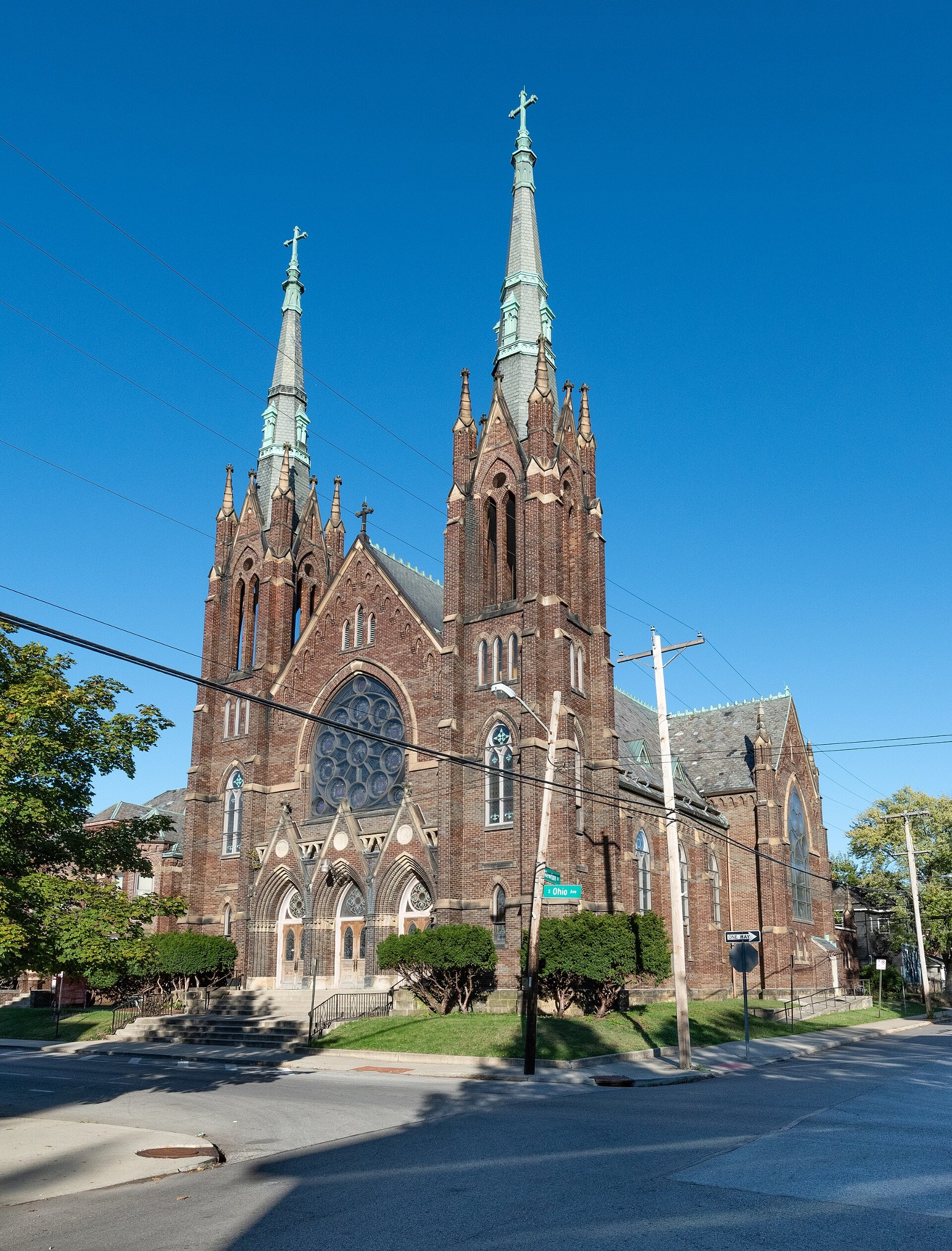
That uncertainty has heightened alarm among local preservationists, historians, and Near East Side residents. Advocacy group Columbus Landmarks designated the complex as one of the city's Most Endangered Sites following its closure. The vulnerability of St. John has grown increasingly acute as the Catholic Diocese of Columbus pursues aggressive real estate maneuvers across the city, including applications filed in September 2026 to demolish its longtime downtown administrative headquarters for a surface parking lot and to raze the historic 1913 Holy Family School in Franklinton.
An Architectural Anchor in Vitrified Brick
The St. John campus represents one of the most cohesive late-19th-century Catholic complexes remaining on Columbus's East Side. Designed by ecclesiastical architect William P. Ginther and completed in 1899, the High Gothic church building was erected with rock-faced vitrified brick). The interior was built to accommodate an original seating capacity of 800), crowned by a soaring 32-foot-high altar reredos and illuminated by elaborate stained-glass windows donated by early congregants.
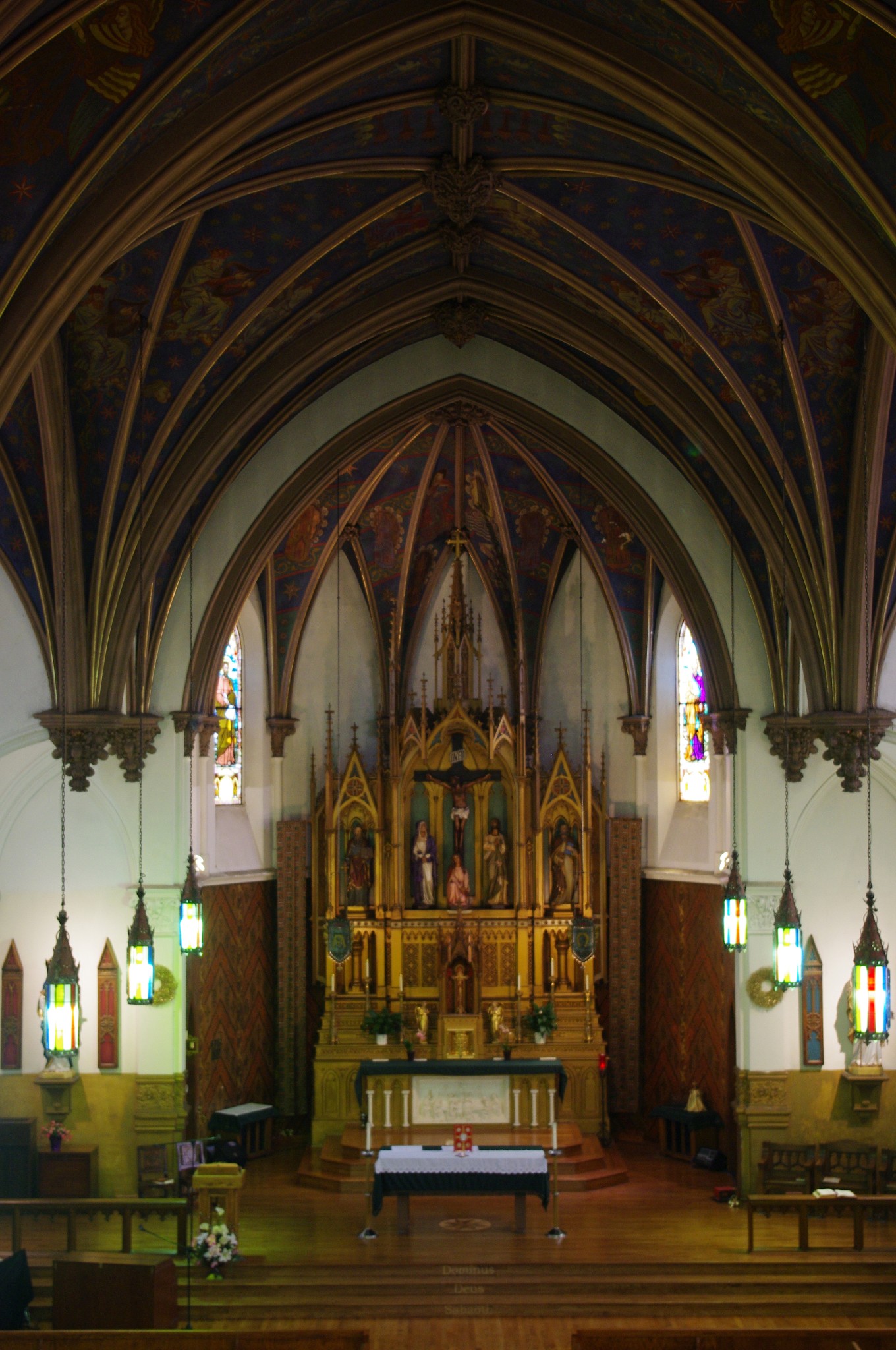
The sanctuary windows hold deep ties to early diocesan history, featuring depictions of the Four Evangelists as well as an Ascension of Jesus in honor of Bishop Watterson) and the Adoration of the Magi honoring Columbus’s first bishop, Sylvester Rosecrans.
Flanking the church along South Ohio Avenue is a collection of complementary institutional structures. The brick rectory was completed in 1899, followed in 1905 by a dedicated parish school designed by Columbus architect David Riebel). Riebel, who served as the first architect of Columbus City Schools and designed over 40 school buildings, utilized matching dark vitrified brick to give the parish complex an architecturally unified street frontage. The complex was rounded out by a convent built to house the Sisters of St. Francis of Penance and Christian Charity, who staffed the school.
From German Immigrant Bastion to Black Catholic Beacon
While founded in 1897 to serve German-American Catholics living near the Pontifical College Josephinum on East Main Street, the church underwent a profound demographic and cultural evolution during the mid-20th century. As the construction of Interstate 70 cut through surrounding residential neighborhoods and white flight altered the city's urban core, the neighborhood became majority African American.
Rather than withdrawing, the parish adapted. In May 1979, the diocese merged neighboring Holy Rosary Church into St. John, forming the Community of Holy Rosary-St. John). Within a decade of the union, the congregation was approximately 70% black).
The parish emerged as a progressive crucible for Black Catholic liturgical expression and grassroots community empowerment. During the mid-1980s, the parish embraced gospel music within its Catholic liturgy, causing attendance to more than double. The church hosted annual commemorative Masses for Martin Luther King Jr. Day) and served as a forum for prominent national figures, including an address by the Rev. George Stallings Jr. during a parish revival in 1986).
That activism extended directly into community care. In 1971, the parish established the St. John Community Center), providing food distributions, emergency aid, and educational outreach to Near East Side residents. Even after Sunday liturgies ceased in 2024, the school building has continued to house lifeline programs, including a food pantry, adult learning classes, and a free medical clinic sponsored by the Sovereign Military Order of Malta).
Diocesan Property Moves Stoke Demolition Anxieties
Preservationists fear the campus could become the next casualty in a broader diocesan pattern of property disinvestment and demolition. Under Bishop Fernandes, the diocese has faced public scrutiny over how it handles surplus and aging properties across the urban core.
In September 2026, the diocese filed plans with the Columbus Planning Division seeking a Certificate of Appropriateness to demolish its five-story administrative headquarters at 197 E. Gay St., a building constructed in 1908 that it has owned since the 1960s. The property, which sits directly behind St. Joseph Cathedral, has housed diocesan central offices, Catholic Social Services, and the Our Lady of Guadalupe Center.
According to application documents filed with the city, the diocese proposed building demolition “and conversion to surface parking”. While an unsafe building order was issued for 197 E. Gay St. following a partial brick wall collapse in January 2026, city building officials confirmed that the diocese had pulled no demolition permits with the Department of Building and Zoning Services prior to filing its commission request. When asked by reporters about the rationale for demolishing the Gay Street building and creating a parking lot, a diocesan spokesperson replied that the diocese had nothing to add beyond what was stated on the application.
Simultaneously, an application was filed to demolish the historic Holy Family School at 57 S. Grubb Street in Franklinton. Constructed in 1913 in the Romanesque Revival style, Holy Family School famously served as a dry refuge for residents when the Great Flood devastated Franklinton that same year. Despite later housing the Jubilee Museum and a basement soup kitchen serving up to 300 in need daily, the building was listed by Columbus Landmarks as a Most Endangered Site amid intense neighborhood redevelopment pressures. The September 2026 demolition filing confirmed community fears that the historic Catholic structure would be cleared.
Municipal Review Hurdles and Preservation Options
The diocese’s demolition agenda faces regulatory resistance in municipal commission rooms. At Gay Street, any razing requires formal approval from the Downtown Commission, which historically disfavors leveling historic structures solely to construct surface parking lots unless the applicant demonstrates extreme structural failure that cannot be remediated.
In Old Oaks, St. John Catholic Church sits within a designated historic district recognized on the National Register of Historic Places, giving the property significant standing among city preservation advocates. Yet national register status alone does not permanently insulate buildings from demolition permits if a property owner demonstrates financial hardship or structural decay.
When the diocese closed Holy Rosary-St. John, it cited millions of dollars in needed building repairs. Columbus Landmarks cautioned that the fate of these historic structures remains uncertain. Community leaders and preservationists argue that any future disposition of the St. John complex must respect both its architectural mastery and its decades of social ministry to Columbus’s Black community, rather than repeating the pattern of demolition seen across the diocese's urban portfolio.
How we know this
The sources and records behind this story, with the facts they support.
https://en.wikipedia.org/wiki/Saint_John_the_Evangelist_Church_(Columbus,_Ohio)
Supporting evidence (12)
Dominic Church on January 17, 2024, citing dwindling attendance and deferred maintenance costs across aging facilities.
Read supporting passage
January 17, 2024.[58] The Columbus Diocese stated that this was in part due to low Mass attendance and deteriorating facilities which necessitated millions of dollars of repairs.
The diocese held its final Mass in the building on May 12, 2024, and Fernandes formally deconsecrated the church on January 21, 2026, stripping the consecrated space of its sacred status and leaving its future wholly undefined.
Read supporting passage
January 17, 2024.[58] The Columbus Diocese stated that this was in part due to low Mass attendance and deteriorating facilities which necessitated millions of dollars of repairs.
Ginther and completed in 1899, the High Gothic church building was erected with rock-faced vitrified brick.
Read supporting passage
January 17, 2024.[58] The Columbus Diocese stated that this was in part due to low Mass attendance and deteriorating facilities which necessitated millions of dollars of repairs.
The interior was built to accommodate an original seating capacity of 800, crowned by a soaring 32-foot-high altar reredos and illuminated by elaborate stained-glass windows donated by early congregants.
Read supporting passage
January 17, 2024.[58] The Columbus Diocese stated that this was in part due to low Mass attendance and deteriorating facilities which necessitated millions of dollars of repairs.
The sanctuary windows hold deep ties to early diocesan history, featuring depictions of the Four Evangelists as well as an Ascension of Jesus in honor of Bishop Watterson and the Adoration of the Magi honoring Columbus’s first bishop, Sylvester Rosecrans.
Read supporting passage
January 17, 2024.[58] The Columbus Diocese stated that this was in part due to low Mass attendance and deteriorating facilities which necessitated millions of dollars of repairs.
The brick rectory was completed in 1899, followed in 1905 by a dedicated parish school designed by Columbus architect David Riebel.
Read supporting passage
January 17, 2024.[58] The Columbus Diocese stated that this was in part due to low Mass attendance and deteriorating facilities which necessitated millions of dollars of repairs.
John, forming the Community of Holy Rosary-St.
Read supporting passage
January 17, 2024.[58] The Columbus Diocese stated that this was in part due to low Mass attendance and deteriorating facilities which necessitated millions of dollars of repairs.
Within a decade of the union, the congregation was approximately 70% black.
Read supporting passage
January 17, 2024.[58] The Columbus Diocese stated that this was in part due to low Mass attendance and deteriorating facilities which necessitated millions of dollars of repairs.
The church hosted annual commemorative Masses for Martin Luther King Jr.
Read supporting passage
January 17, 2024.[58] The Columbus Diocese stated that this was in part due to low Mass attendance and deteriorating facilities which necessitated millions of dollars of repairs.
George Stallings Jr. during a parish revival in 1986.
Read supporting passage
January 17, 2024.[58] The Columbus Diocese stated that this was in part due to low Mass attendance and deteriorating facilities which necessitated millions of dollars of repairs.
In 1971, the parish established the St.
Read supporting passage
January 17, 2024.[58] The Columbus Diocese stated that this was in part due to low Mass attendance and deteriorating facilities which necessitated millions of dollars of repairs.
Even after Sunday liturgies ceased in 2024, the school building has continued to house lifeline programs, including a food pantry, adult learning classes, and a free medical clinic sponsored by the Sovereign Military Order of Malta.
Read supporting passage
January 17, 2024.[58] The Columbus Diocese stated that this was in part due to low Mass attendance and deteriorating facilities which necessitated millions of dollars of repairs.
https://columbuslandmarks.org/2024-most-endangered-sites/
Supporting evidence (4)
The diocese held its final Mass in the building on May 12, 2024, and Fernandes formally deconsecrated the church on January 21, 2026, stripping the consecrated space of its sacred status and leaving its future wholly undefined.
Read supporting passage
The Catholic diocese closed the parish providing services on May 12, 2024. The fate of these historic structures remains uncertain at this time.
Advocacy group Columbus Landmarks designated the complex as one of the city's Most Endangered Sites following its closure.
Read supporting passage
The Catholic diocese closed the parish providing services on May 12, 2024. The fate of these historic structures remains uncertain at this time.
Riebel, who served as the first architect of Columbus City Schools and designed over 40 school buildings, utilized matching dark vitrified brick to give the parish complex an architecturally unified street frontage.
Read supporting passage
The Catholic diocese closed the parish providing services on May 12, 2024. The fate of these historic structures remains uncertain at this time.
Columbus Landmarks cautioned that the fate of these historic structures remains uncertain.
Read supporting passage
The Catholic diocese closed the parish providing services on May 12, 2024. The fate of these historic structures remains uncertain at this time.
https://columbusunderground.com/church-wants-to-tear-down-5-story-downtown-building-bw1/
Supporting evidence (4)
In September 2026, the diocese filed plans with the Columbus Planning Division seeking a Certificate of Appropriateness to demolish its five-story administrative headquarters at 197 E.
Read supporting passage
The Roman Catholic Diocese of Columbus has submitted plans to the City of Columbus to demolish a five-story Downtown building it has owned since the 1960s.ADVERTISEMENT The building, which was constructed in 1908 and is located at 197 E. Gay St.
According to application documents filed with the city, the diocese proposed building demolition “and conversion to surface parking”.
Read supporting passage
The Roman Catholic Diocese of Columbus has submitted plans to the City of Columbus to demolish a five-story Downtown building it has owned since the 1960s.ADVERTISEMENT The building, which was constructed in 1908 and is located at 197 E. Gay St.
When asked by reporters about the rationale for demolishing the Gay Street building and creating a parking lot, a diocesan spokesperson replied that the diocese had nothing to add beyond what was stated on the application.
Read supporting passage
The Roman Catholic Diocese of Columbus has submitted plans to the City of Columbus to demolish a five-story Downtown building it has owned since the 1960s.ADVERTISEMENT The building, which was constructed in 1908 and is located at 197 E. Gay St.
Simultaneously, an application was filed to demolish the historic Holy Family School at 57 S.
Read supporting passage
The Roman Catholic Diocese of Columbus has submitted plans to the City of Columbus to demolish a five-story Downtown building it has owned since the 1960s.ADVERTISEMENT The building, which was constructed in 1908 and is located at 197 E. Gay St.
https://columbuslandmarks.org/holy-family-school/
Supporting evidence (3)
Simultaneously, an application was filed to demolish the historic Holy Family School at 57 S.
Read supporting passage
Holy Family School was about to open in 1913 when the Great Flood overwhelmed Franklinton and the surrounding area. The basement flooded but the school provided refuge for many from lower ground. The school was designed in a Romanesque Revival style with ornamental parapets.
Constructed in 1913 in the Romanesque Revival style, Holy Family School famously served as a dry refuge for residents when the Great Flood devastated Franklinton that same year.
Read supporting passage
Holy Family School was about to open in 1913 when the Great Flood overwhelmed Franklinton and the surrounding area. The basement flooded but the school provided refuge for many from lower ground. The school was designed in a Romanesque Revival style with ornamental parapets.
Despite later housing the Jubilee Museum and a basement soup kitchen serving up to 300 in need daily, the building was listed by Columbus Landmarks as a Most Endangered Site amid intense neighborhood redevelopment pressures.
Read supporting passage
Holy Family School was about to open in 1913 when the Great Flood overwhelmed Franklinton and the surrounding area. The basement flooded but the school provided refuge for many from lower ground. The school was designed in a Romanesque Revival style with ornamental parapets.