
Holy Family School Demolition Requires Binding East Franklinton Review Board Approval
City officials confirmed the East Franklinton Review Board holds binding authority over demolition permits, while advocates launched a petition to pause demolition.
The proposed demolition of the former Holy Family School cannot proceed merely upon the expiration of a municipal 60-day administrative hold, as the historic Franklinton building falls under the binding regulatory jurisdiction of the East Franklinton Review Board, city officials confirmed.
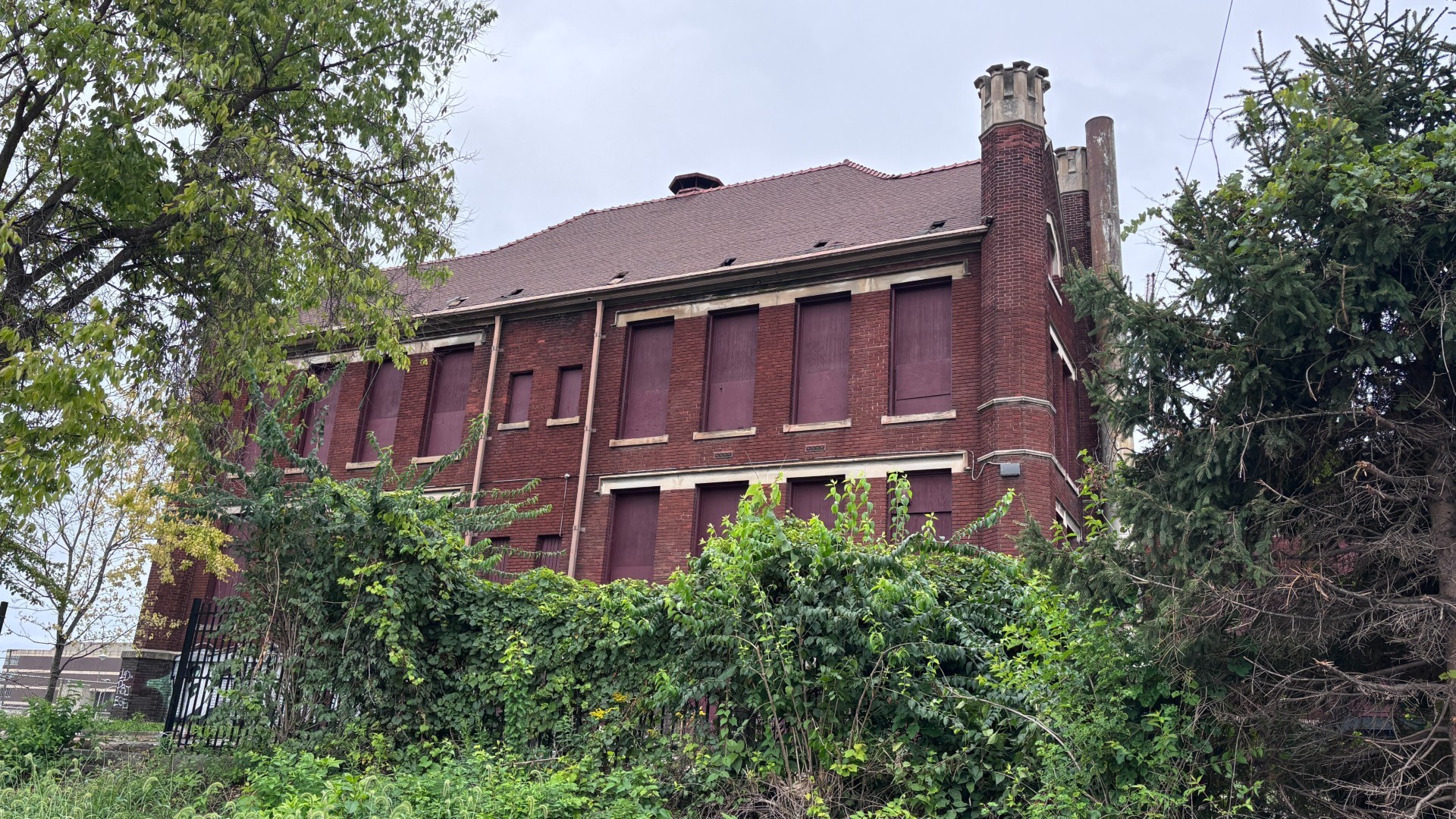
The vacant former Holy Family School building at 57 S. Grubb St. in Franklinton stands boarded up with overgrown foliage.
Credit: Brent Warren / Columbus Underground Image source
The Catholic Diocese of Columbus, which owns the building, applied to have the former Holy Family School at 57 S. Grubb Street torn down. Demolition company S.G. Loewendick & Sons filed the application on Sept. 21 to demolish the more than 45,000-square-foot building. At the October 13 meeting of the Franklinton Area Commission, the commission voted 8-1 against approving a demolition permit for the building, but area commission votes are only advisory.
Binding Review Board Jurisdiction
Mark Dravillas, Planning Administrator for the City of Columbus, spoke at the meeting, suggesting that “all parties involved should familiarize themselves with the process” of the East Franklinton Review Board. Christine Reedy, spokesperson for the Columbus Department of Development, confirmed that the review board will need to vote on the proposed demolition, and that a demolition permit won’t be issued until a Certificate of Appropriateness (also called a Certificate of Approval) has been issued by that board.
Reedy pointed to city code section 3323.11(H), which lays out the process for the approval of demolition permits within the East Franklinton District: “Except in cases of public emergency as determined by the Chief Building Official or by court order, no permit for the demolition of a building or structure within the East Franklinton District shall be granted without the approval of the Review Board through issuance of a Certificate of Approval.” The code specifies that no certificate shall be issued unless: A replacement use has been reviewed and approved by the board, and Historic Resources Commission (HRC) approval has been issued, if applicable, or If no replacement structure or use is proposed, a plan detailing how the property will be maintained has been reviewed and approved by the board.
Under standard municipal procedures, a spokesperson for the city's Department of Building and Zoning Services previously explained that the applicant can choose to go to the Franklinton Area Commission to ask permission to take down the building right away, or can simply wait the required 60 days, at which point the permit will be issued and demolition can begin (the window expires on November 20). However, the East Franklinton Review Board exercises distinct regulatory oversight. The city's design review boards and historic commissions hold binding votes rather than recommendations, having played a role in stopping demolitions or altering plans in the past. No application for a Certificate of Appropriateness had been received by the city ahead of an Oct. 20 submission deadline for the board's scheduled meeting on Oct. 28.
Diocese Cites Costs and Refuses to Sell Land
The Catholic Diocese of Columbus submitted a letter to the Franklinton Area Commission prior to its Oct. 13 meeting outlining extensive financial and safety challenges at the site. The letter stated that the building is owned by the Holy Family Parish, which does not have the funds to renovate it, asking “why would the parish, which does not have the money, spend tens of millions of dollars to rebuild a structure that does not currently serve the needs of the people of the parish in Franklinton? While the building does have a long history, it no longer serves the needs of the community.”
The diocese detailed severe safety concerns, noting that unhoused residents and others have forced entry into the structure, punched holes in the roof, and set fires inside it. A diocese representative said the diocese had examined renovation costs for ministerial uses such as a school and got an estimate of $20 million.
In response to questions from Columbus Landmarks, the diocese confirmed it has not marketed the building for sale because it does not want to sell the property, although it previously reached out to developers to explore potential preservation partnerships without finding any takers. When asked about the possibility of partnering with other groups to preserve the building, the representative repeated concerns about the structure's condition, stating: “if you’re not coming with $20-million plus to fix it up, we’re all wasting our time.”
Community Advocates Launch Petition
Holy Family School was about to open in 1913 when the Great Flood overwhelmed Franklinton, and the school provided refuge for many from lower ground. The school was designed in a Romanesque Revival style with ornamental parapets. The building at 57 S. Grubb St. has been on Columbus’ endangered properties list since 2020.
Community advocates are pushing to repurpose the structure into a centralized services facility. Tonia Vargas, executive director of the nonprofit Just Believe Personal Enrichment Corp., proposed acquiring and restoring the property into a hub providing housing resources, workforce development, a soup kitchen and other community services. Advocates have estimated adaptive-reuse renovations at between $5 million and $12 million, though that estimate has not been independently verified.
In an appeal posted online on Oct. 18, organizers ask: “If you think historic buildings should get a second chance at serving their communities, consider signing.” In the petition, Just Believe Personal Enrichment Corp. and Ronald Coleman (whose great-uncle founded the Holy Family soup kitchen in 1979) want to transform it into a Community Wellness and Resource Center, asking officials to pause demolition and give this a real chance. The petition urges that The Diocese and city leaders just need to explore preservation options, allow for professional inspections, and consider a partnership.
Video Watch video 0:33
Pique’s reporting on the same events, newest first.
Downtown Latest
Downtown Commission Takes No Action on Columbus Diocesan Office Demolition Proposal
City planners found replacing the five-story building with surface parking is inconsistent with downtown zoning code and design guidelines.
Franklinton You are reading
Holy Family School Demolition Requires Binding East Franklinton Review Board Approval
Near East
Preservation Fears Mount Over Historic St. John Church Amid Columbus Diocesan Demolitions
Deconsecrated after decades anchoring Black Catholic worship and neighborhood outreach in Old Oaks, the 1898 Gothic landmark faces an ambiguous future as the diocese moves to raze older downtown and Franklinton properties.
How we know this
The sources and records behind this story, with the facts they support.
Supporting evidence (2)
The Catholic Diocese of Columbus, which owns the building, applied to have the former Holy Family School at 57 S. Grubb Street torn down.
Read supporting passage
The former Holy Family School at 57 S. Grubb Street now houses the Holy Family Soup Kitchen and Food Pantry. The Jubilee Museum, which once occupied the building, has moved downtown and become the Museum of Catholic Art and History. The Catholic Diocese of Columbus, which owns the building, recently applied to have it torn down.
Demolition company S.G. Loewendick & Sons filed the application on Sept. 21 to demolish the more than 45,000-square-foot building.
Read supporting passage
Demolition company S.G. Loewendick & Sons filed the application on Sept. 21 to demolish the more than 45,000-square-foot building, according to NBC4 WCMH-TV.
https://columbusunderground.com/review-board-could-hold-up-plan-to-demolish-historic-building-bw1/
Supporting evidence (15)
At the October 13 meeting of the Franklinton Area Commission, the commission voted 8-1 against approving a demolition permit for the building, but area commission votes are only advisory.
Read supporting passage
The October 13 meeting of the Franklinton Area Commission featured several speakers, including Chris Hune of Columbus Landmarks, Tonia Vargas of Just Believe Personal Enrichment Corp., and a spokesperson for the Catholic Diocese of Columbus. The commission voted at the end of the meeting 8-1 against approving a demolition permit for the building, but area commission votes are only advisory
Mark Dravillas, Planning Administrator for the City of Columbus, spoke at the meeting, suggesting that “all parties involved should familiarize themselves with the process” of the East Franklinton Review Board.
Read supporting passage
Mark Dravillas, Planning Administrator for the City of Columbus, also spoke at the meeting, suggesting that “all parties involved should familiarize themselves with the process” of the East Franklinton Review Board (EFRB), which will also get a chance to weigh in on the case.
Christine Reedy, spokesperson for the Columbus Department of Development, confirmed that the review board will need to vote on the proposed demolition, and that a demolition permit won’t be issued until a Certificate of Appropriateness (also called a Certificate of Approval) has been issued by that board.
Read supporting passage
Christine Reedy, spokesperson for the city’s Department of Development, confirmed to Columbus Underground that the EFRB will need to vote on the proposed demolition, and that a demolition permit won’t be issued until a Certificate of Appropriateness (also called a Certificate of Approval) has been issued by that board.
Reedy pointed to city code section 3323.11(H), which lays out the process for the approval of demolition permits within the East Franklinton District: “Except in cases of public emergency as determined by the Chief Building Official or by court order, no permit for the demolition of a building or structure within the East Franklinton District shall be granted without the approval of the Review Board through issuance of a Certificate of Approval.”
Read supporting passage
Reedy pointed to this section of city code (3323.11 H), which lays out the process for the approval of demolition permits within the East Franklinton District:
Reedy pointed to city code section 3323.11(H), which lays out the process for the approval of demolition permits within the East Franklinton District: “Except in cases of public emergency as determined by the Chief Building Official or by court order, no permit for the demolition of a building or structure within the East Franklinton District shall be granted without the approval of the Review Board through issuance of a Certificate of Approval.”
Read supporting passage
Except in cases of public emergency as determined by the Chief Building Official or by court order, no permit for the demolition of a building or structure within the East Franklinton District shall be granted without the approval of the Review Board through issuance of a Certificate of Approval.
The code specifies that no certificate shall be issued unless: A replacement use has been reviewed and approved by the board, and Historic Resources Commission (HRC) approval has been issued, if applicable, or If no replacement structure or use is proposed, a plan detailing how the property will be maintained has been reviewed and approved by the board.
Read supporting passage
No certificate shall be issued unless: A replacement use has been reviewed and approved by the board, and Historic Resources Commission (HRC) approval has been issued, if applicable, or If no replacement structure or use is proposed, a plan detailing how the property will be maintained has been reviewed and approved by the board
The city's design review boards and historic commissions hold binding votes rather than recommendations, having played a role in stopping demolitions or altering plans in the past.
Read supporting passage
The city’s design review boards and historic commissions have more clout than area commissions – their votes are binding, not just recommendations – and they have played a role in stopping demolitions or at least slowing down or altering plans in the past.
No application for a Certificate of Appropriateness had been received by the city ahead of an Oct. 20 submission deadline for the board's scheduled meeting on Oct. 28.
Read supporting passage
No application for a Certificate of Appropriateness has been received so far, according to the city, and the submission deadline for the next EFRB meeting is October 20.
No application for a Certificate of Appropriateness had been received by the city ahead of an Oct. 20 submission deadline for the board's scheduled meeting on Oct. 28.
Read supporting passage
The next meeting of the EFRB is October 28.
The letter stated that the building is owned by the Holy Family Parish, which does not have the funds to renovate it, asking “why would the parish, which does not have the money, spend tens of millions of dollars to rebuild a structure that does not currently serve the needs of the people of the parish in Franklinton?
Read supporting passage
is owned by the Holy Family Parish, which does not have the funds to renovate it.
The letter stated that the building is owned by the Holy Family Parish, which does not have the funds to renovate it, asking “why would the parish, which does not have the money, spend tens of millions of dollars to rebuild a structure that does not currently serve the needs of the people of the parish in Franklinton?
Read supporting passage
why would the parish, which does not have the money, spend tens of millions of dollars to rebuild a structure that does not currently serve the needs of the people of the parish in Franklinton? While the building does have a long history, it no longer serves the needs of the community.
The diocese detailed severe safety concerns, noting that unhoused residents and others have forced entry into the structure, punched holes in the roof, and set fires inside it.
Read supporting passage
The letter also detailed a long list of safety concerns, including the fact that unhoused residents and others have forced entry into the structure, punched holes in the roof, and set fires inside it.
A diocese representative said the diocese had examined renovation costs for ministerial uses such as a school and got an estimate of $20 million.
Read supporting passage
The representative said that the Diocese had looked into how much it would cost to renovate the building for “ministerial uses,” such as a school, and got an estimate of $20 million.
In response to questions from Columbus Landmarks, the diocese confirmed it has not marketed the building for sale because it does not want to sell the property, although it previously reached out to developers to explore potential preservation partnerships without finding any takers.
Read supporting passage
In response to a question from Hune, the CEO of Columbus Landmarks, he said that the Diocese has not marketed the building for sale because it does not want to sell the property, although the organization did reach out to developers to gauge interest in a partnership of some sort that might lead to the building being saved (they did not get any takers).
When asked about the possibility of partnering with other groups to preserve the building, the representative repeated concerns about the structure's condition, stating: “if you’re not coming with $20-million plus to fix it up, we’re all wasting our time.”
Read supporting passage
When she asked about the possibility of the Diocese partnering with other groups to preserve the building, the representative repeated his concerns about the state of the building; “if you’re not coming with $20-million plus to fix it up, we’re all wasting our time.”
https://columbusunderground.com/plans-filed-to-demolish-former-school-museum-building-bw1/
Supporting evidence (1)
Under standard municipal procedures, a spokesperson for the city's Department of Building and Zoning Services previously explained that the applicant can choose to go to the Franklinton Area Commission to ask permission to take down the building right away, or can simply wait the required 60 days, at which point the permit will be issued and demolition can begin (the window expires on November 20).
Read supporting passage
A spokesperson for the city’s Department of Building and Zoning Services explained that, for the Holy Family building, the applicant can choose to go to the Franklinton Area Commission to ask permission to take down the building right away, or can simply wait the required 60 days, at which point the permit will be issued and demolition can begin (the window expires on November 20).
https://columbuslandmarks.org/holy-family-school/
Supporting evidence (2)
Holy Family School was about to open in 1913 when the Great Flood overwhelmed Franklinton, and the school provided refuge for many from lower ground.
Read supporting passage
Holy Family School was about to open in 1913 when the Great Flood overwhelmed Franklinton and the surrounding area. The basement flooded but the school provided refuge for many from lower ground.
The school was designed in a Romanesque Revival style with ornamental parapets.
Supporting evidence (3)
The building at 57 S. Grubb St. has been on Columbus’ endangered properties list since 2020.
Tonia Vargas, executive director of the nonprofit Just Believe Personal Enrichment Corp., proposed acquiring and restoring the property into a hub providing housing resources, workforce development, a soup kitchen and other community services.
Read supporting passage
Tonia Vargas, executive director of Just Believe Personal Enrichment Corp., a Columbus-based nonprofit, wants to acquire and restore the property to provide housing resources, workforce development, a soup kitchen and other community services.
Advocates have estimated adaptive-reuse renovations at between $5 million and $12 million, though that estimate has not been independently verified.
Read supporting passage
Community advocates estimate renovations could cost between $5 million and $12 million, though that estimate has not been independently verified.
Supporting evidence (5)
In an appeal posted online on Oct. 18, organizers ask: “If you think historic buildings should get a second chance at serving their communities, consider signing.”
Read supporting passage
Posted=2026-10-18T11:32:48Z
In an appeal posted online on Oct. 18, organizers ask: “If you think historic buildings should get a second chance at serving their communities, consider signing.”
Read supporting passage
If you think historic buildings should get a second chance at serving their communities, consider signing.
In the petition, Just Believe Personal Enrichment Corp. and Ronald Coleman (whose great-uncle founded the Holy Family soup kitchen in 1979) want to transform it into a Community Wellness and Resource Center, asking officials to pause demolition and give this a real chance.
Read supporting passage
Now, Just Believe Personal Enrichment Corp. and Ronald Coleman (whose great-uncle founded the Holy Family soup kitchen in 1979) want to transform it into a Community Wellness and Resource Center
In the petition, Just Believe Personal Enrichment Corp. and Ronald Coleman (whose great-uncle founded the Holy Family soup kitchen in 1979) want to transform it into a Community Wellness and Resource Center, asking officials to pause demolition and give this a real chance.
Read supporting passage
The ask is simple: pause demolition and give this a real chance.
The petition urges that The Diocese and city leaders just need to explore preservation options, allow for professional inspections, and consider a partnership.
Read supporting passage
The Diocese and city leaders just need to explore preservation options, allow for professional inspections, and consider a partnership.